Downpipe Tuning : Real Gains and Legality

In the world of car tuning, the downpipe holds a central place for enthusiasts looking to improve their vehicle’s performance. This mechanical modification, often seen as a key lever to optimize exhaust gas flow, nevertheless raises debates and questions, particularly about the real benefits in terms of power and its legal compliance. While some announce spectacular gains, it is important to rigorously examine the actual effects of the downpipe in the engine’s performance chain. Moreover, the regulatory aspect related to emission standards and technical inspections complicates matters for those considering this optimization.
Furthermore, modern mechanics, integrated with complex electronic management systems, require a calibrated and precise approach. The simple installation of a downpipe does not automatically guarantee measurable results without appropriate reprogramming. This complexity is reinforced by restrictions imposed by certification, European and national legislation on pollutant emissions. For tuning specialists, this is therefore a technical challenge that intersects both the quest for power and compliance with these legal frameworks.
Through this article, we will analyze in detail the different aspects of downpipe tuning: how it affects engine performance, what real gains can be observed under optimal conditions, what legal implications must be considered, as well as complementary optimization paths to this modification. The objective is to offer a thorough technical vision, supported by examples from real cases such as the preparation of iconic cars like the Audi RS3, Subaru Impreza WRX STI, or BMW M3. The tuning downpipe thus appears not only as a mechanical choice but also as a step in a global strategy for performance improvement.
Technical impact of the downpipe on engine performance and real gains
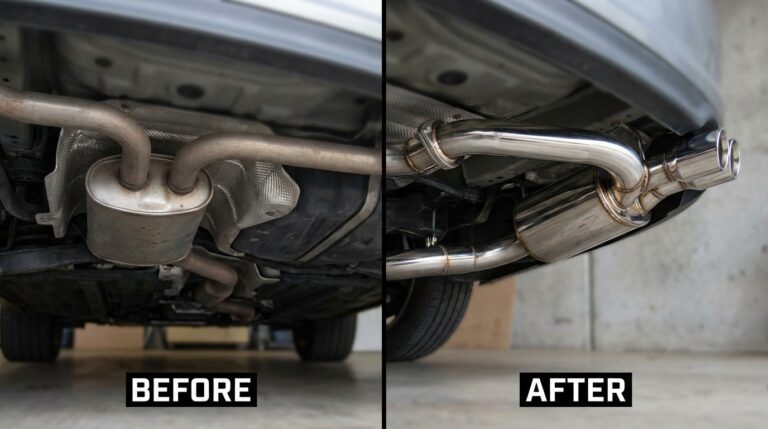
The downpipe is a crucial part of the exhaust system, placed directly after the turbo in most turbocharged engines. Its main role is to facilitate the evacuation of burnt gases from the turbo to the rest of the exhaust circuit, by reducing back pressure. This reduction promotes better engine breathing, which generally translates into real gains in power and torque. However, it is crucial to distinguish the real effects of the downpipe from the theoretical gains claimed without measured bases.
A stock downpipe is often equipped with a high-flow catalyst or a standard catalyst that somewhat limits gas flow. Switching to a performance downpipe often devoid of a catalyst (or with a sport catalyst) significantly increases the volume and speed of gas evacuation. This reduces wasted load in the turbo, allowing it to operate more efficiently. For example, on an Audi RS3, whose stock mechanics include a highly stressed turbo, replacing it with an adapted downpipe combined with engine remapping can generate up to 30 to 50 additional horsepower depending on configurations, a progression sometimes felt from low revs.
In practice, gains also depend on the engine type and its original condition. Naturally aspirated engines will not benefit as much as a turbocharged one. The Subaru WRX STI prepared for rally, for instance, sees a clear improvement in engine response and better heat management thanks to an optimized downpipe, as shown in this detailed preparation. This gain is also noticeable in terms of smoothness and acceleration feel.
However, these performances cannot be obtained without an adjusted engine mapping. Electronic management must be redesigned to fully exploit the potential of the new gas evacuation, notably by adapting boost pressure and the air/fuel mixture. This is where the notion of optimization fits into the overall tuning process, the downpipe being only a part of the chain inherent to performance.
Finally, gains are not only measured in horsepower. The reduction of turbo lag, that is the delay between pressing the accelerator and the turbo’s reaction, is also a benefit appreciated by many sporty drivers. This better fluidity provides superior driving comfort and notable efficiency on circuits or winding roads.
Legality and compliance: between technical modifications and emission regulations
Despite the performance advantages offered, the downpipe raises major questions in terms of legality. In France as in many European countries, modification of the exhaust system is subject to strict standards, notably those related to pollutant emissions. Every component of the exhaust system must be certified to comply with current regulations. In particular, the catalytic converter must strictly meet the criteria defined by manufacturer certification. Replacing the original downpipe with a non-certified part risks non-compliance detectable during technical inspection or later environmental checks.
This issue is all the more complex as anti-pollution measures have tightened in recent years, in the context of the fight against urban pollution and global warming. A downpipe without a catalyst or with a sport catalyst certainly reduces back pressure but also modifies emissions of NOx, CO2, and particulate matter. Vehicles equipped with this type of modification can therefore exceed authorized limit thresholds, which entails legal danger and sometimes a risk to the engine itself.
It is therefore essential to precisely inform oneself about the applicable legislation in 2026 and to choose either a CE-certified downpipe or a solution including an efficient catalytic system meeting Euro 6 standards or later. Some federations or tuning clubs provide databases on certified parts, ensuring owners traceability and the possibility of certification.
Beyond the technical inspection, in case of vehicle sale or accident, the presence of a non-compliant downpipe may engage the owner’s liability, especially with regard to insurance. It is thus recommended to accompany every modification with technical documentation proving the certification of the installed parts.
In the strict context of BMW M3 preparation, for example, the search for performance is often compatible with legality by adopting validated parts, as described in this comprehensive M3 tuning guide. Compliance with standards remains a fundamental criterion for daily and durable use.
Complementary optimization techniques associated with the downpipe to maximize power
Installing a downpipe represents only one step in a global process of improving engine performance. To maximize gains, it is advisable to follow up with other technical modifications that, combined, significantly improve engine response and durability. Among the essential optimizations are engine remapping, turbo pressure increase, and improvements to the intake system.
Engine remapping is indispensable after installing a performance downpipe. It involves recalibrating the ECU (electronic control unit) to readjust injection, turbo pressure, and thermal management. Without this step, the engine does not fully benefit from the new gas flows and gains are limited. This adjustment must be carried out by experts, using dynamometers and sophisticated diagnostic tools.
Meanwhile, turbo or wastegate modification, as well as an optimized cold air intake system, largely contribute to performance. A more responsive turbo combined with a downpipe free from restrictions enhances driving pleasure by offering constant torque over a wide rev range. It also helps better manage exhaust gas temperatures, thus limiting premature deterioration risks.
Here is a list of common modifications in a complete preparation including a downpipe:
- Replacing the downpipe with a performance or sport catalyst model
- ECU remapping on a dynamometer to adjust injection and turbo pressure
- Turbo upgrade or installation of a larger turbo kit
- Improvement of the air intake system with a high-performance filter
- Installation of a complete exhaust system to further reduce back pressure
- Reinforcement of engine cooling and air/air intercooler
These combined steps can transform a vehicle like an Audi RS3 into a true road beast, as well explained by the detailed preparation process to reach 500 horsepower in this thorough analysis. The continuous optimization of the exhaust system, engine, and electronics provides a balanced yield between power, reliability, and compliance.
Comparative performance study: stock downpipe versus tuning downpipe
To better understand the real contribution of a tuning downpipe, it is interesting to analyze classical data collected during dynamometer tests. A comparative table based on several popular vehicles clearly illustrates the measured gains, taking into account standard and modified conditions.
| Vehicle | Stock downpipe (hp) | Tuning downpipe (hp) | Power gain (hp) | Associated modifications |
|---|---|---|---|---|
| Audi RS3 | 400 | 445 | +45 | Remapping, sport catalyst |
| Subaru WRX STI | 310 | 340 | +30 | Remapping, improved intake |
| BMW M3 E92 | 420 | 460 | +40 | Stage 2, downpipe, complete exhaust |
This data demonstrates that tuning downpipes allow a real increase in efficiency. However, it also shows that optimal performance depends on a global approach. Without the association of engine remapping, the potential of the downpipe itself is rarely fully exploited.
Recommendations for a compliant and effective downpipe installation
For anyone considering modifying their exhaust system via a tuning downpipe, it is essential to respect certain rules to avoid technical or legal setbacks. Here are some practical tips based on field experience and recent regulations:
- Choose a certified downpipe: Opt for CE-certified parts that guarantee compliance with emission standards and simplify administrative procedures.
- Plan for appropriate remapping: Ensure optimal calibration to fully benefit from the modification and preserve engine reliability.
- Check exhaust system integrity: Make sure the new part fits properly without leaks or risks damaging the turbo or lambda sensor.
- Keep technical documents: Retain certification certificates to present at technical inspections or in case of resale.
- Inform yourself about local legislation: Some urban areas restrict the use of modified vehicles, an aspect to consider before any installation.
Tuning preparation is never a trivial act, especially concerning a component as critical as the downpipe. A rigorous approach, combining quality parts and professional expertise, is necessary to reconcile performance and safety. This approach is frequently illustrated in extreme preparation projects such as those available on many Subaru STI realizations, reflecting best practices to adopt.
What is a downpipe in tuning?
The downpipe is a part of the exhaust system located after the turbo, allowing to reduce back pressure and improve evacuation of burnt gases. This modification is popular in tuning to increase power and engine responsiveness.
What are the real gains obtained with a downpipe?
Real gains vary depending on the vehicle and associated modifications, but generally an increase of 20 to 50 horsepower and a significant reduction of turbo lag can be observed, especially on turbocharged engines.
Is the downpipe legal in France?
Legality depends on compliance with emission standards and part certification. A non-certified downpipe may cause failure at technical inspection and sanctions. It is recommended to use certified parts and keep certificates.
Is it necessary to remap the ECU after installing a downpipe?
Yes, remapping is essential to optimize engine management by adapting injection and turbo pressure to the new gas evacuation conditions, thus obtaining the best performance gains.
What are the risks of installing a non-compliant downpipe?
Risks include increased pollutant emissions, mechanical problems linked to poor combustion, sanctions during technical inspection, and potential nullity of warranty or insurance in case of accident.