Décata Tuning : Legal or Illegal in France ?


Car tuning remains an exciting and technical world where every modification aims to boost performance, sound, or aesthetics. Among these adjustments, Decata Tuning – that is, the removal of the catalytic converter from the exhaust system – sparks intense debate in France. This choice offers notable advantages in terms of power and engine sound but also fuels controversy from a legal and environmental point of view. Despite its popularity among enthusiasts, it inevitably confronts its followers with a strict regulatory framework, notably in the context of ever stricter emission standards. The objective is clear: to reduce the environmental impact of automotive pollution while ensuring the safety of vehicles on the road. So, what is the true legal status of a decatalyzed exhaust on a car in France? Is it a tolerated engine modification, sanctioned, or outright forbidden? This in-depth analysis, combining technical aspects, regulations, and practical cases, invites you to dive into the multiple facets of decata tuning to understand all legal implications and associated risks.
The technical and mechanical basics of Decata Tuning in the French car tuning scene
To fully understand the stakes of decata tuning, it is essential to grasp the precise role of the catalytic converter. This central component of the exhaust system serves to reduce harmful emissions resulting from engine combustion. By retaining and transforming polluting gases into less dangerous substances, it helps comply with environmental regulations regarding automotive pollution. The removal or optimization of the catalytic converter thus constitutes a significant mechanical modification, often aimed at freeing the exhaust gas flow and improving engine power.
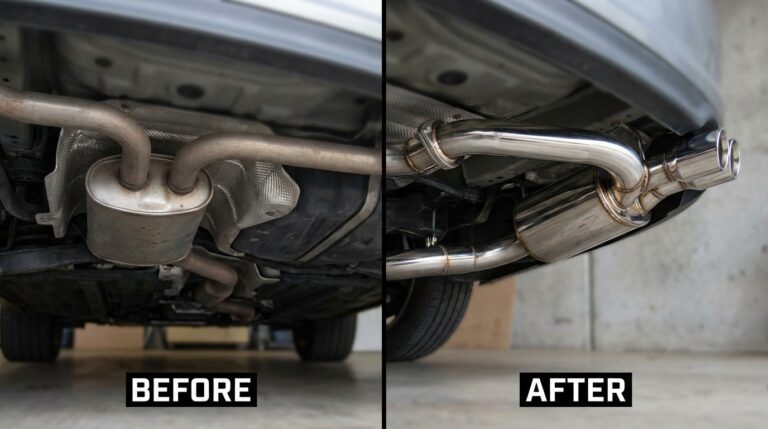
Technically, a decatalyzed exhaust involves replacing the catalytic converter with a straight pipe or a less restrictive muffler. This reduces backpressure of the gases, increases flow, and allows better engine breathing. The benefits are measurable: a gain of several horsepower, quicker throttle response, and a more aggressive sound highly sought after by tuning enthusiasts in France.
However, this mechanical improvement comes at a cost in terms of pollutant emissions. The catalytic converter plays an indispensable role in transforming nitrogen oxides, carbon monoxide, and unburned hydrocarbons. Its removal therefore causes a direct increase in these pollutants, which goes against the increasingly strict emission standards. For example, a Peugeot 208 equipped with a decatalyzed exhaust often records an increase of 40 to 60% in pollutant emissions compared to the original setup.
Within the technical world of tuning, it is important to note that alternatives exist such as sports catalytic converters or reversible decata systems, limiting negative effects while preserving performance. The complexity of these modifications requires advanced expertise, far beyond the intervention of amateur mechanics. Engine modification around decata tuning must be approached as a delicate operation, requiring suitable equipment and a thorough understanding of mechanical and environmental constraints.
Legal framework and current environmental regulations concerning decatalyzed exhausts
The legality of decata tuning in France falls within a very strict regulatory framework. Authorities pay particular attention to enforcing emission norms and vehicle compliance in the context of technical inspections. Thus, the removal of the catalytic converter constitutes a modification that directly violates pollutant emission regulations since the introduction of Euro 4 and Euro 5 standards. In practice, a decatalyzed exhaust is considered an illegal engine modification in the majority of cases.
This illegality is based on several legal texts. The European Directive 2007/46/EC requires that every new vehicle meets specific emission limits and retains its pollution control system intact throughout its lifespan. In France, the Highway Code specifies that any unauthorized alteration or non-compliance with technical standards may lead to penalties, including driving bans. The French car tuning scene is thus regulated to limit practices deemed harmful to the community and the environment.
The technical inspection plays a major role in detecting vehicles whose exhaust has been modified. The defect or absence of the catalytic converter manifests as elevated pollution levels measured on the test bench. Offenders face mandatory retests, or even temporary or permanent driving bans. Non-compliance with this regulation also exposes offenders to tuning-related legal penalties, which may include substantial fines or vehicle confiscation in case of repeated offenses or gross negligence.
Several concrete examples illustrate these legal measures. For instance, a driver caught without a catalytic converter in the Ile-de-France region may receive a 135-euro fine and be required to bring their vehicle back into compliance before being legally allowed to use it on public roads. Law enforcement officers and technical inspectors also use specific devices that quickly identify signs of decatalyzed exhausts, facilitating the fight against this forbidden practice.
Environmental impact and challenges related to French and European emission standards
Vehicle pollutant emissions are a major environmental challenge, especially in large French urban areas. Decata tuning increases harmful emissions, compromising efforts to improve air quality and combat climate change. The catalytic converter, a true technical balance, is designed to limit emissions of carbon monoxide (CO), hydrocarbons (HC), and nitrogen oxides (NOx), which are implicated in various respiratory and cardiovascular diseases.
Statistically, removing the catalytic converter can significantly increase these pollution levels. This phenomenon contradicts international environmental commitments, notably those under the European Green Deal, which aims to drastically reduce pollutant emissions. French administrations also align their inspections to ensure every vehicle complies with the manufacturer’s technical prescriptions.
The stakes of combating road pollution are well-documented by publicly available studies. Low Emission Zones (LEZs) have been established in metropolitan areas such as Lyon, Grenoble, or Paris, where the presence of non-compliant vehicles, particularly those fitted with decatalyzed exhausts, leads to access bans and penalties. These measures demonstrate a political will to act locally for cleaner air.
Here is a list of the main pollutants and their associated health consequences in the context of decata tuning:
- Carbon monoxide (CO): toxic, can cause nervous system damage and cardiovascular disorders.
- Nitrogen oxides (NOx): respiratory irritants, aggravate asthma and are involved in urban smog formation.
- Unburned hydrocarbons (HC): carcinogenic factors, contribute to photochemical pollution.
Within this framework, it becomes clear that car tuning in France must combine passion with respect for environmental regulations, under penalty of severely compromising public health and facing harsh restrictions.
Practical consequences for drivers: technical inspections and legal tuning penalties
During a technical inspection, the vehicle undergoes a thorough check including pollution emission tests. The removal of the catalytic converter is quickly detected due to the absence of the component and pollutant levels exceeding legal thresholds. In this context, the driver is generally subject to a failed inspection that may lead to serious consequences.
Penalties related to decata tuning cover several levels of severity:
- Refusal at the technical inspection: the vehicle must pass a retest after being brought back into compliance, which involves reinstalling a certified catalytic converter.
- Fines: penalties that can reach several hundred euros are applicable during road checks by law enforcement.
- Driving bans: in certain urban areas such as LEZs, non-compliant vehicles are banned, resulting in significant usage restriction.
- Legal risks: in case of repeat offenses or non-compliant modifications, legal action with enhanced penalties may be pursued.
Beyond penalties, drivers with a decatalyzed exhaust also risk degrading engine performance if the electronic management system does not adapt correctly, representing a paradox between seeking power and real technical constraints.
A summary table of penalties related to decata tuning in France provides a clear overview:
| Offense | Penalty | Practical consequences |
|---|---|---|
| Non-approved catalytic converter removal | Fixed fine of €135 (can rise to €375 in case of increase) | Failed technical inspection, obligation to bring back into compliance |
| Driving in a Low Emission Zone without compliance | Fine up to €135 and possible immobilization | Entry ban into the LEZ |
| Repeat offense or dangerous modification | Judicial penalties with up to 2 years imprisonment | Vehicle confiscation, legal proceedings |
To avoid these inconveniences, the best solution is to master car tuning in France by choosing approved and standards-compliant equipment, while enjoying optimized and legal engine tuning. Tuning on a Subaru Impreza WRX STI, for example, can include advanced modifications while complying with rules through the use of certified products.
Legal alternatives to Decata Tuning and prospects for regulatory evolution in France
Facing increasing constraints, French car tuning enthusiasts seek legal solutions to improve their vehicle’s performance without breaking the rules. Several alternatives to decata tuning exist:
- Replacement with a sports catalytic converter: it allows better gas flow while remaining compliant with emission standards, offering a good compromise between power and environmental respect.
- Software optimization (engine remapping): adjustment of engine parameters without altering the physical part of the exhaust, improving power and torque while respecting emission limits.
- Certified high-performance exhaust: installation of exhaust systems with certified components that combine aesthetics, sound, and legality.
- Technical datasheets and certification: resorting to certified professionals specialized in French car tuning to ensure engine modifications comply with legislation.
Moreover, regulations evolve regularly under the pressure of environmental and technological challenges. There is a trend towards European harmonization that incorporates new standards related to hybrid and electric engines, as well as increased monitoring of tuning practices to prevent abuses.
A crucial point concerns future regulations integrating onboard sensors and tests both in laboratories and real driving conditions (RDE – Real Driving Emissions), which should make non-compliance virtually impossible during modifications like decata tuning. These advances promise better control of automotive pollution, benefiting citizens while promoting more responsible tuning.
Ultimately, pursuing legal tuning activities requires constant vigilance and an informed choice of technical solutions, within a changing legal environment. Enthusiasts must imperatively inform themselves and prioritize certified products to avoid penalties and ensure a peaceful use of their vehicle on French territory.
What is decata tuning?
Decata tuning involves removing or replacing the catalytic converter of the exhaust system to improve gas flow and increase engine power, which has the side effect of increasing pollutant emissions.
Is decata tuning legal in France?
No, the removal of the catalytic converter without approval is illegal in France and exposes the driver to penalties during the technical inspection or road checks.
What are the penalties for a decatalyzed exhaust?
Penalties can range from a fixed fine to a driving ban, up to legal proceedings and vehicle confiscation in case of repeat offenses.
Are there legal alternatives to decata tuning?
Yes, such as approved sports catalytic converters, engine remapping, or certified exhausts that allow performance improvements while respecting emission standards.
How does the technical inspection detect a decatalyzed exhaust?
The technical inspection measures pollutant emissions and verifies the physical presence of the catalytic converter. Absence or non-compliance leads to inspection refusal.