Intercooler Performance : Real Power Gains

In the world of automotive mechanics, the role of the intercooler is often underestimated, even though it is a key component in the quest for power gain, especially on turbo engines. This part, beyond its technical aspect, directly impacts engine optimization by ensuring effective cooling of the compressed air by the turbo. This air cooling improves the charge density within the cylinders, which optimizes combustion and consequently the overall engine performance. In 2026, advances in the design and thermal efficiency of intercoolers push even further the limits of engine potential, offering real and measurable power gains for tuning enthusiasts and automotive professionals.
As turbo pressure increases to extract ever more power from the engine, the air charge becomes hotter and less dense, reducing the efficiency of this forced induction. The intercooler thus constitutes the main tool to counter this effect, ensuring optimal cooling and maximized efficiency. However, simply adding an intercooler is not enough: its performance depends on many factors such as its size, type (air-to-air or air-to-water), position, and integration within the forced induction system. Understanding these technical challenges not only allows better grasping of possible power gains but also helps avoid common mistakes during advanced engine tuning.
Operation and importance of the intercooler in turbocharging
The intercooler plays a fundamental role in automotive mechanics, particularly on engines equipped with turbochargers. When the turbo compresses the air, the temperature of this air naturally increases, which decreases its density and prevents the introduction of an optimal amount of oxygen into the combustion chamber. The intercooler thus acts as a cooling stage, lowering the temperature of the compressed air before it enters the engine, which increases the oxygen charge and allows better combustion.
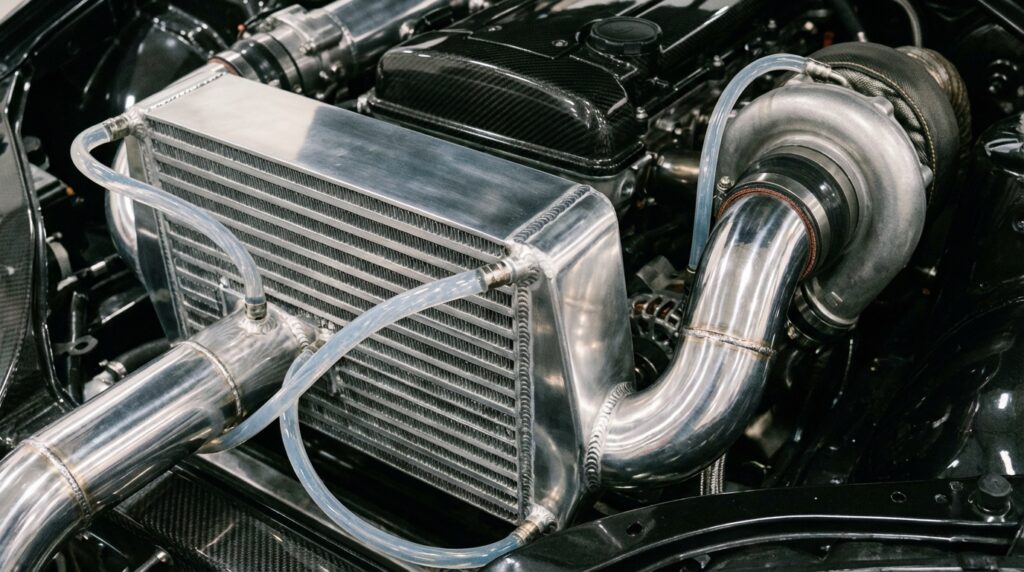
Technically, there are two main types of intercoolers: air-to-air intercoolers and air-to-water intercoolers. The first uses ambient air to cool the turbo compressed air, while the second uses a dedicated coolant circuit. Each technology has advantages and limitations in terms of thermal efficiency and mechanical integration.
The direct impact on engine performance
A well-sized and optimized intercooler allows raising turbo pressure by ensuring effective cooling of the compressed air. The power gain is mainly explained by better combustion enabled by increased oxygen density. This improvement also affects engine reliability by reducing the risks of knocking caused by too high temperature in the combustion chamber, which could damage internal components.
In practice, the difference is particularly felt during acceleration phases where the turbo operates at full capacity. Poor cooling, for example through an undersized intercooler, will result in a noticeable drop in performance and accelerated engine overheating. Conversely, an oversized but well-designed system will maintain performance over time, including under extreme conditions.
This article on complete turbo preparation for the Subaru WRX illustrates these principles applied to a specific model, with practical demonstrations of power gains obtained and necessary optimizations.
The different types of intercoolers and their impact on power gain
Understanding the variations between air-to-air and air-to-water intercoolers is essential to optimize engine performance. Each type presents technical characteristics that directly influence cooling capacity and therefore achievable power gain.
Air-to-air intercooler: simplicity and raw efficiency
This type of intercooler is the most commonly used in the automotive industry, mainly for reasons of ease of installation and maintenance. It works by direct exchange between the hot compressed air from the turbo and the fresh ambient air circulating through the radiator fins.
Its thermal efficiency essentially depends on two factors: exchange surface area and external airflow. The colder the outside air and the higher the airflow, the more optimal the cooling will be. This means that this system delivers better performance when driving at high speed, as airflow naturally increases.
However, in urban environments or in hot weather, cooling performance decreases, directly affecting the power delivered by the engine. Moreover, these intercoolers can be bulky and cause fluctuating turbo pressure, which sometimes requires adjustments to engine electronic management, as found in some setups like Audi RS3 tuning exceeding 500hp.
Air-to-water intercooler: advanced technology for better stability
Air-to-water intercoolers use a liquid circulating in a closed circuit to absorb heat from the compressed air. This liquid is then cooled through a dedicated radiator. This design allows for more consistent cooling regardless of vehicle speed or external conditions.
The air-to-water technology is often favored in high-performance and competitive applications, where cooling precision and turbo pressure stability are critical. For example, this configuration is often chosen during a stage 3 tuning with extreme modifications, where each additional power step demands strict temperature control.
| Type of intercooler | Advantages | Disadvantages | Typical applications |
|---|---|---|---|
| Air-to-air | Simple, economical, easy maintenance | Performance varies depending on conditions, bulky size | Production cars, stages 1 and 2 tuning |
| Air-to-water | Constant cooling, better thermal control | Complex liquid circuit, high costs | Competition, stage 3 tuning |
Engine and intercooler optimization: strategies to maximize power gain
The role of the intercooler in engine optimization is part of a global chain of improvements, all aimed at increasing efficiency and power. It is not enough to simply replace the component; its impact on turbo pressure, engine electronic management (ECU), and forced induction system must also be considered.
An effective optimization strategy includes:
- Precise analysis of turbo pressure: adapting pressure based on the intercooler’s capacity to cool compressed air.
- Calibration of engine management: adjusting injection and ignition parameters to take advantage of increased oxygen density.
- Integration of thermal sensors: real-time monitoring of air temperature to prevent overheating.
- Modernization of the forced induction system: sometimes coupled with a turbo change or preparations like complete N55 preparation on BMW 335i.
This combined approach truly maximizes power gains while ensuring better durability of mechanical components. The choice and installation of the intercooler must imperatively be taken into account in a global tuning project accompanied by specific remapping, under penalty of not fully exploiting engine potential.
Measuring the real power gains linked to the intercooler
To evaluate the effectiveness of an intercooler in a specific setup, it is crucial to have precise measurement tools. The dynamometer is the reference to verify increased power and turbo pressure management. Sensors are also available to measure intake air temperature before and after the intercooler, as well as instantaneous turbo pressure.
Results can sometimes be surprising: a poorly adapted intercooler or one with insufficient heat exchange can even cause power loss due to partial overheating or excessive back pressure. On the other hand, a well-sized model will allow for power gains of up to 10 to 15% in certain cases, especially on highly modified turbocharged engines.
| Measured parameter | Before optimization | After optimization with high-performance intercooler | Comments |
|---|---|---|---|
| Wheel power (hp) | 280 | 320 | +14% real gain measured |
| Intake air temperature (°C) | 75 | 45 | Significant cooling |
| Turbo pressure (bar) | 1.5 | 1.8 | Possible increase without risk |
To deepen these concepts and integrate this data into a complete project, the case study on A45 AMG tuning from stage 1 to stage 3 offers a relevant overview of concrete benefits brought by a high-performance intercooler coupled with global engine optimization.
Maintenance and complementary modifications to maximize the efficiency of the intercooler
Maintaining the performance of an intercooler depends not only on its choice but also on rigorous maintenance and adapted vehicle modifications. An intercooler clogged with dust, dirt, or oil will lose thermal efficiency and jeopardize engine reliability. Regular cleaning of fins, checking hoses, and preventing leaks are essential actions.
Complementary modifications can also increase cooling capacity and thus power gain. Among these:
- Installation of dedicated electric fans to improve airflow at idle.
- Use of high thermal conductivity materials for heat pipes and structure.
- Improvement of under-hood aerodynamics to maximize fresh air flow towards the intercooler.
- Installation of a heat shield to minimize heat radiated from the engine towards the intercooler.
All these actions help extend the intercooler’s lifespan and maintain stable turbo pressure, a key parameter to avoid premature failures and guarantee consistent performance over the long term.
Enthusiasts and professionals wishing to deepen their knowledge can consult detailed resources such as essential modifications for Clio RS or strategic choices between tuning stages as illustrated in Mercedes AMG stage 1 vs stage 2.
What is the main role of an intercooler in a turbo engine?
The intercooler cools the air compressed by the turbo to increase its density, allowing better combustion and thus a real power gain.
What are the advantages of an air-to-water intercooler compared to an air-to-air intercooler?
The air-to-water intercooler offers more constant and stable cooling, regardless of external conditions, improving thermal efficiency and turbo pressure stability.
How to evaluate the power gain after installing an intercooler?
The dynamometer and measurement of intake air temperature before and after the intercooler are the main methods to evaluate performance improvements.
What are best practices for maintaining a high-performance intercooler?
Regularly cleaning the fins, checking for leaks, replacing aging hoses, and improving airflow around the intercooler ensure optimal efficiency.
Can a high-performance intercooler be installed without engine remapping?
It is strongly recommended to accompany the installation of a high-performance intercooler with an ECU remap to adjust turbo pressure and optimize combustion, thus maximizing power gain.