What is the difference between a paint job and a wrap?

What is the difference between a paint job and a wrap? Painting involves restoring (or replacing) the topcoat applied directly to the vehicle’s bodywork, while wrapping is a vinyl film applied over the original paint to change the appearance or protect the surface. In practice, painting permanently alters the surface, whereas wrapping is reversible (it can be removed) if the application and maintenance have been carried out correctly.
When you want to change the look of a car, protect its bodywork, or correct cosmetic flaws, two solutions consistently come up: painting and wrapping. They don’t address the same constraints or serve the same purposes: budget, downtime, level of customization, resistance to everyday wear and tear (UV rays, micro-scratches, stone chips), and even resale value. Confusion is common, especially since the visual result can be very similar on a high-end wrap.
To make an informed choice, you need to compare what happens “beneath the surface”: preparation, application, repairability, longevity, and technical limitations (angles, edges, complex bumpers). We’ll also clear up some common misconceptions: no, a wrap doesn’t “replace” damaged paint, and no, paint isn’t always “better” than vinyl film. The key is to match the solution to the vehicle’s intended use and the desired result.
Painting vs. vehicle wrapping: definition, principle, and final result
Before discussing price or durability, it is necessary to understand what each solution actually “does” to the vehicle. What is the difference between a paint job and a wrap? Technically, the difference lies in the fact that paint is a coating applied in layers (primer, base, varnish) which polymerizes and becomes bonded to the substrate, whereas covering is a thermoformable adhesive film placed on the surface, held in place by a pressure-sensitive adhesive.
Automotive paint: a permanent coating that depends heavily on preparation
Modern automotive paintwork is generally a two- or three-layer system: surface preparation (sanding, degreasing), possibly repairs (filler, high-build primer), then application of the colored base coat and clear coat. The result is “fused” with the bodywork: paintwork isn’t removed like a film. It can be sanded, polished, buffed, corrected, partially repainted… but the process remains irreversible.
The finish of a high-quality paint job, carried out under optimal conditions (controlled booth, temperature, and humidity), is remarkably consistent: depth of gloss, clear coat tension, pearlescent or metallic effects, and color stability. Paint is also the historical benchmark for OEM (original equipment manufacturer) finishes. However, this quality depends 80% on proper preparation. Paint applied to a poorly prepared surface can exhibit:
- dust or inclusions (cabin defects),
- orange peel (orange skin),
- drips,
- micro-veils,
- a difference in shade between panels.
In other words, a painting can be extraordinary… or very disappointing if the process or the know-how is not up to standard.
Vehicle wrapping: an aesthetic and/or protective vinyl film, reversible under certain conditions
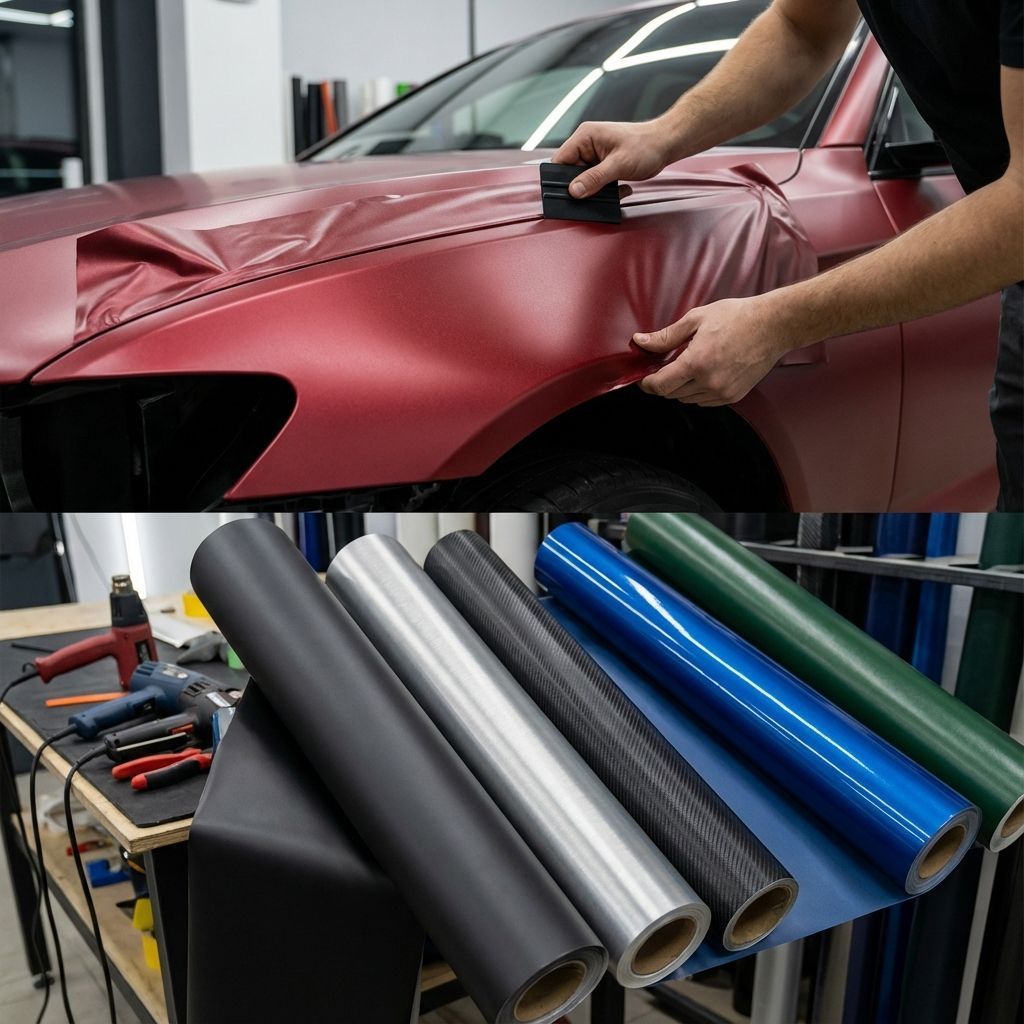
Vehicle wrapping (or “coating”) involves applying a vinyl film (cast or calendered, depending on the application) to the vehicle’s body. The film is heated to conform to the vehicle’s shape, then smoothed down to remove air bubbles and ensure adhesion. Wraps can be total (full wrap) or partial (roof, hood, stripes, mirrors, chrome delete).
The final result depends on the film (quality, thickness, finish) and the quality of the installation. Many finishes are available:
- glossy, satin, matte
- Carbon fiber effects, brushed metal, glitter, chameleon
- very credible “manufacturer-like” colors,
- textured films.
An important distinction: vehicle wrapping is often chosen for a quick style change, but it can also serve a protective function. In this case, it’s called paint protection film (PPF) when the primary objective is impact and scratch resistance, although some PPFs do come in a satin finish.
In short, What is the difference between a paint job and a wrap? The paintwork “becomes” the vehicle’s finish, while the wrap “dresses up” the existing finish. This point influences everything else: preparation, repairs, total cost, and long-term strategy.
Cost, time and downtime: what you’re really paying for
Budget is often the number one criterion. But comparing only a “full paint job vs. full wrap” price is misleading: the cost items are not the same. To answer this question effectively… What is the difference between a paint job and a wrap?You need to look at what makes up the bill, the time spent, and the vehicle immobilization.
Cost of a paint job: preparation labor + environment + consumables
A serious, comprehensive painting project generally involves:
- Partial dismantling (handles, trim strips, mirrors, lights depending on trim level),
- preparation (sanding, masking, degreasing),
- repairs (filler, primer, fixing defects),
- painting (base coat + varnish)
- drying/steaming,
- finishing (polishing, dust removal, quality control).
What you’re paying for is primarily skilled labor and a specific environment: paint booth, filtration system, solvent and waste management, and consumables. The price range is enormous: a “low-cost paint job” may exist, but often at the expense of disassembly, preparation, or clear coat quality. On a recent vehicle, a complete, high-quality paint job can quickly become expensive, especially if you’re aiming for a near-OEM finish on all doors and interior panels (jambs).
In terms of turnaround time, we often hear of several days to several weeks depending on the workshop’s workload, the extent of the repairs, and the level of detail required (exterior paint only vs. interior door panels, engine bay, etc.). Downtime is therefore a significant issue.
Vehicle wrapping cost: cost of the film + installation expertise + complexity of the shapes
A high-quality vehicle wrap is structured differently:
- washing/decontamination,
- thorough degreasing,
- Removal of certain elements depending on the level (logos, antenna, trim parts),
- Film cutting/application, thermoforming, edge finishing
- Stabilization time, checks and possible touch-ups.
The film itself has a significant cost, especially for premium brands (3M, Avery Dennison, Oracal, Hexis, etc.) and specific finishes. Labor is also a major factor: a vehicle with many curves, air intakes, sharp angles, and added parts requires more time and expertise.
In general, vehicle downtime is often shorter than with a full paint job, but you must factor in application time, adhesive stabilization (especially after heating), and sometimes a “resting” period before high-pressure washing. Vehicle wrapping also has the advantage of being modular: you can do a roof, mirrors, and hood, and then add more later.
SO, What is the difference between a paint job and a wrap? For a comparable budget, painting “buys” durable transformation and substrate correction, while wrapping “buys” a quick and reversible aesthetic transformation — provided you have a sound base.
Durability, maintenance and repairability: what stands the test of time
One of the most practical questions is: “What will age best?” The answer depends on usage (city, highway, outdoor parking, frequent washing), the quality of materials, and maintenance. Here again, What is the difference between a paint job and a wrap? Paint is a hardened system that tolerates correction (polishing), whereas film is a polymer material more sensitive to certain treatments, but replaceable panel by panel.
Aging: UV rays, micro-scratches, chemicals and climate
Paint A quality clear coat is highly resistant to UV rays, bird droppings (if removed promptly), insects, and regular washing. Micro-scratches appear with aggressive washing, but these can be corrected by polishing (within certain limits of clear coat thickness). A well-maintained car can retain its beautiful paintwork for a long time, especially if it is protected with wax, sealant, or ceramic coating.
Covering A quality vinyl film generally lasts several years, but its longevity depends heavily on:
- from UV exposure (south-facing parking, altitude),
- depending on the type of finish (matte and satin finishes often show more marks),
- washing (high pressure too close to the edges, aggressive brushes),
- maintenance (degreasers, prohibited solvents, suitable shampoos).
Some films can fade, crack, or shrink if the quality is average or if the edge-bonding technique wasn’t properly executed. Very bright colors or certain special effects can also age more quickly in sunlight.
Anecdote (field) A black sedan owner I saw in the shop had chosen a “premium” matte wrap to avoid streaks. After a whole summer parked outside, he was convinced the film had “burned.” In reality, most of the marks on the matte finish came from an overly alkaline car wash product used at the station, which had left halos. Gentle decontamination plus a specific product for matte films restored 80% of the finish. Moral of the story: the wrap can be robust, but it doesn’t like “universal degreasers.”
Repairability: local touch-up vs. panel replacement
If you hit a bumper:
- Paint Touch-ups are possible, but a proper repair often involves reworking, sanding, painting, and blending. Depending on the color (pearlescent, three-layer), an invisible blend requires real expertise.
- Covering You can’t “touch up” a film invisibly. However, you can replace the filmed part (bumper, fender, door) if you have the same film reference. One thing to keep in mind: reserve some extra material from the roll, as a different batch may have slight variations.
For the interview, remember:
- Paint: gentle wash + polishing possible. Highly compatible with ceramic coatings.
- Vehicle wrapping: gentle washing, avoid brushes, avoid strong solvents, caution with high pressure at the edges. Special ceramic coatings for films are available.
In the end, What is the difference between a paint job and a wrap? Paintwork can be “corrected” and polished, while vehicle wrapping can be “replaced” in sections. Neither is superior in all cases: it’s simply a matter of different maintenance.
Preparation, bodywork condition and risks: what they don’t always tell you
This is the point that makes the difference between a good project and a bad one. Many choose a wrap to “hide” a worn-out car body. However, What is the difference between a paint job and a wrap? The wrap doesn’t repair the surface: it follows it. A scratch, a dent, peeling varnish… all of this will be visible, sometimes even more so depending on the finish.
A vehicle wrap requires a sound base: good adhesion, edges, and a weakened clear coat.
A film adheres correctly to original paintwork in good condition. Problems arise when:
- The varnish is peeling off: the film can tear the varnish during removal.
- There are crude touch-ups or a recent paint job that hasn’t cured properly.
- Some areas are very rough (oxidation): the glue does not have a “solid” surface to anchor itself to.
- Raw/textured plastics: not all films last a long time.
Edges and returns are critical. Professional installation often involves post-heating certain areas to stabilize the film and limit shrinkage. Without this step, the wrap can lift at the corners, especially on bumpers.
Important: If the car has been repainted, the risk of damage during removal is higher, as the paint’s adhesion to the surface may be less than that of a factory paint job, depending on the initial preparation. A properly applied wrap shouldn’t remove sound paint, but it can reveal a pre-existing weakness.
A paint can correct and “reconstruct” the surface (but requires a real process)
Painting, on the other hand, allows for the repair of a surface: corrosion treatment, straightening, filling, priming. But this capability comes at a cost and requires a specific method. A paint job done “quickly” by masking instead of dismantling, or without properly treating a rust spot, may look good initially but deteriorate rapidly.
Here is a simple guideline:
- If your bodywork has structural defects (rust, blistering varnish, deep dents, through scratches), the paint (with repair) is often the rational way.
- If your paintwork is generally sound but you want to change the style, protect and preserve the original value, the covering is often very relevant.
Quote “The quality of a finish never exceeds the quality of its preparation.” — a maxim widely shared in the bodywork and painting trades.
In summary, What is the difference between a paint job and a wrap? Vehicle wrapping is like a “second skin”: effective only if the underlying surface is sound. Painting offers a possible “reconstruction” of the surface, but it’s a more involved and demanding process.
How to choose: use, purpose, budget and resale value
Choosing between the two is a matter of arbitrating between reversibility, protection, return, and long-term commitment. What is the difference between a paint job and a wrap? Painting is generally the “definitive” choice, while wrapping is the “strategic” choice (color testing, protection, resale, leasing).
Concrete scenarios: which choice for which profile?
1) Vehicle under lease/LOA or value to be preserved
Vehicle wrapping is often ideal: you protect the original paintwork and you can remove the film before returning the vehicle (depending on the terms of the contract) or selling it. A properly removed wrap often leaves the paintwork in better condition, as it has been less exposed to UV rays and micro-scratches.
2) Project “show car”, unique color, matching door interior
A high-quality paint job (including door pillars, windows, etc.) gives a more professional and uniform finish, especially when the doors and trunk are opened. Wrapping can also cover interior areas, but this increases complexity, and some areas are not well-suited for it.
3) Damaged bodywork / ruined paintwork / corrosion
Painting with a repair kit makes more sense. Putting a wrap over peeling varnish only postpones the problem and adds a risk of removal.
4) Periodic change of appearance (professional, fleet, events)
Vehicle wrapping is unbeatable: colors, patterns, branding, sponsorships—everything is simpler. Plus, printed film allows for customization impossible with paint at a reasonable cost.
5) Impact protection
If protection (from gravel) is the priority, consider PPF (protective film) rather than a traditional cosmetic wrap. Some combinations are available: clear PPF on the front with a colored wrap on the rest.
Resale value, compliance and administrative
Resale value depends on the market: some buyers are wary of a completely repainted car (fearing an accident), even if the paintwork is perfect. A well-documented wrap (invoice, film brand, before/after photos) can be reassuring, as it suggests the original paint has been preserved. Conversely, a wrap can also conceal defects: hence the importance of checking the history.
Regarding compliance: a color change (especially a drastic one) may require administrative procedures depending on the country/regulations. Since vehicle wrapping is reversible, some consider it temporary, but in practice, if the dominant visible color changes permanently, it’s wise to check beforehand.
Practical conclusion: if you are still hesitating, ask yourself these 4 questions:
- Do I want to be able to go back? (if yes: cover)
- Is my car bodywork in good condition? (if not: repair/paint)
- Do I need a perfect finish right down to the door jambs? (often painted)
- I prioritize protection and resale value? (often wrapping/PPF)
And to conclude: What is the difference between a paint job and a wrap? One transforms and repairs permanently, the other dresses, protects and is removed — with specific constraints.
FAQ: Painting or wrapping
Does the wrap damage the original paintwork?
If applied to sound paintwork and removed correctly, a wrap shouldn’t damage the paint. The main risk concerns paintwork that is already weakened (peeling clear coat, touch-ups, poorly adhering non-OEM paint): upon removal, the film can take off a layer of clear coat or paint.
Can you put a wrap on a car that’s already been repainted?
Yes, but you need to assess the adhesion and condition of the paint. Freshly painted surfaces must be fully cured (this time varies depending on the product and process). Testing on a small area is recommended to minimize any unpleasant surprises when removing the paint.
Which solution offers the best protection against gravel?
For impacts, the most protective is the PPF (protective film), designed to absorb impacts. A classic vinyl wrap offers some protection against micro-scratches and UV rays, but it is not optimized for impacts like PPF.
What is the average lifespan of a vehicle wrap?
Its lifespan varies depending on the film’s quality, finish (matte/satin/gloss), sun exposure, and maintenance. Under normal conditions, a properly installed premium film will last several years. Intensive use with permanent outdoor parking will reduce this lifespan.
Does a paint job last longer than a wrap?
Often yes, especially if the paint is high quality and well-maintained. But paint can also deteriorate if it was poorly applied or if the vehicle is subjected to harsh conditions (UV rays, aggressive washing). Vehicle wraps, on the other hand, are easier to replace.
Can you wash a covered car with a roller shutter?
This is not recommended. Rollers and brushes can mark the film, especially during finishing. mast Or satinand can lift edges. Opt for hand washing (microfiber) or a high-pressure wash station, keeping a distance from the edges.
Is vehicle wrapping cheaper than painting?
Often, but not always. A premium wrap on a complex vehicle can approach the cost of a “decent” paint job. The difference widens when compared to a high-end paint job involving disassembly, repairs, and extensive finishing.
Which solution gives the most “original manufacturer” look?
A paint job done to the highest standards generally gives the most OEM-like finish, especially on internal areas (pillars, contours). A high-end wrap can look very convincing from the outside, but it’s still just an additional layer.
Conclusion
What is the difference between a paint job and a wrap? Paint is a permanent finish that can also be used to restore the bodywork (repairs, surface correction), while wrapping is a film applied over the existing paint, designed to change the appearance and/or protect the vehicle, with the added benefit of being reversible. Paint is chosen when you’re aiming for a permanent transformation, a uniform finish down to the smallest detail, and the ability to “rebuild” a worn surface. Wrapping is chosen when you want to preserve the original paint, test a color, quickly personalize your vehicle, or facilitate resale.
The best choice depends less on the “most elegant solution” than on the actual condition of the bodywork, your daily use, and the desired level of finish. Before deciding, have the surface inspected (varnish, touch-ups, edges), ask for examples of comparable work, and demand details about the preparation: this is what makes the difference between a spectacular result… and one that ages poorly.