Mirror Coverings: The Detail That Changes Everything

In the world of car customization, mirror wrapping is often perceived as a minor detail. Yet, this precise modification adds an aesthetic and functional dimension that can transform a car’s appearance. Whether for optimal protection against external damage or to emphasize the vehicle’s visual identity, adhesive film applied to mirrors is emerging as a strategic choice at the heart of wrapping trends in 2026. With refined technology and increasingly meticulous finishes, this painstaking process has become essential for enthusiasts and professionals looking to combine style and durability on surfaces that were once neglected.
The growing popularity of mirror wrapping also reflects the rise of subtle customization across the automotive landscape. More than just a color or design, wrapping offers genuine personalized protection, limiting the risk of scratches, impacts, or wear and tear caused by the elements. This technical innovation now strikes an exemplary balance between performance and aesthetics, with specific films adapted to the curvature and various materials of mirror housings. The result: a clean, uniform, and durable finish that enhances the overall look of the vehicle without disrupting its style.
Choosing the right adhesive film for rearview mirror covering: criteria and technical specifications
Choosing the right film is crucial for successful rearview mirror wrapping. These surfaces are subject to greater mechanical and environmental stresses than the bodywork. Therefore, the film must combine elasticity, optimal adhesion, and UV resistance. Among the options, the main choices are polymeric and monomeric vinyl films, each with characteristics suited to specific applications.
Polymer vinyl It stands out for its increased flexibility, allowing for application on the curved and complex surfaces of mirror housings without creasing. Its durability is also superior, an essential quality against gravel impacts and regular friction. For high-end finishes, polymer films with scratch-resistant treatment and enhanced UV protection are preferred, prolonging the integrity of the decoration and providing mechanical protection.
Monomeric vinylThis more economical option is generally intended for temporary installations or seasonal customization. Its lower resistance to deformation and wear limits its use on high-traffic surfaces, but it remains suitable for quick aesthetic experiments or low-cost adjustments. However, this choice should be limited to moderate exposure conditions.
The film’s thickness also plays a key role. A film that is too thin may offer less protection, while a film that is too thick can cause installation difficulties, especially on small, compact rearview mirrors. Several manufacturers have updated their product lines to offer ultra-thin films with excellent coverage and enhanced adhesion, thus optimizing the ease of application for technicians.
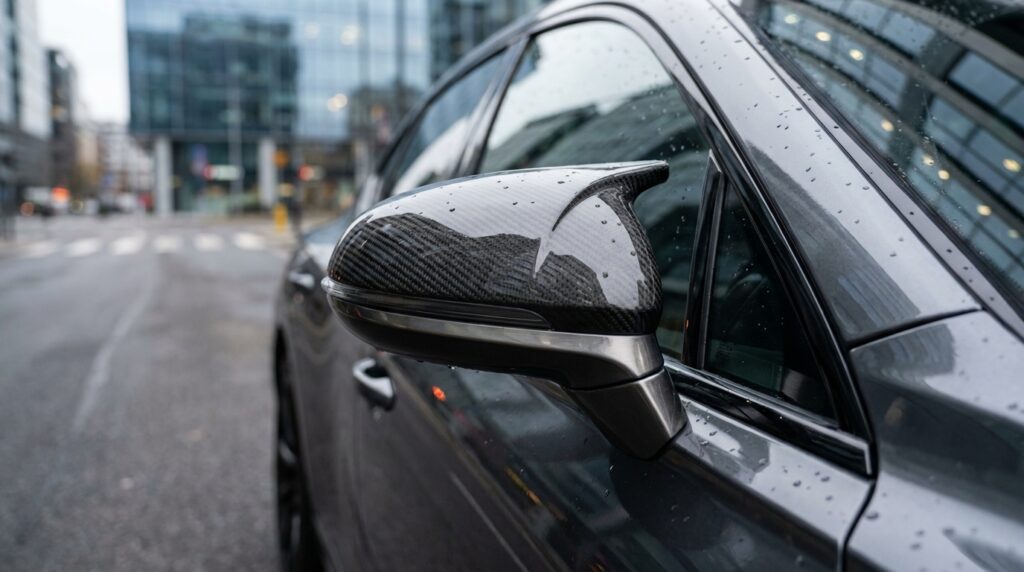
Moreover, the texture and finish of the adhesive film significantly impact the final aesthetic result. Depending on preference, a matte finish can offer a sleek and modern look, while a satin film adds depth with a subtle sheen. Glossy finishes are often used for a mirror or metallic effect, enhancing the perception of volume and technology. For those who appreciate refined details, there are even carbon fiber or micro-textured metallic films, adding a sporty and high-end touch.
Finally, compatibility with the surface of the rearview mirrors (plastic, ABS, aluminum) requires careful film selection to ensure flawless adhesion and prevent bubbles or premature peeling. To guarantee a perfect result, it is essential to be familiar with the specific technical requirements for surface preparation before wrapping. Careful preparation remains the essential base for a durable and aesthetically pleasing wrap.
Advanced techniques for applying wraps to rearview mirrors: mastering the details of car wrapping
Applying decals to rearview mirrors requires specific technical expertise, far more delicate than applying them to large, flat body surfaces. Indeed, the small size, rounded shape, and contours of the mirror housings necessitate precise movements and adapted methods to avoid bubbles, creases, or tears.
First, meticulous surface cleaning is essential. Any dust or trace of grease compromises the film’s adhesion and threatens its durability. Using specific solvents and lint-free microfiber cloths is the foundation of perfect preparation.
Next, the initial cutting of the oversized film facilitates precise fitting onto the rearview mirrors. It is advisable to allow an extra margin, often 3 to 5 cm, to cover the edges and corners for a clean finish. This step can be optimized by using templates or patterns designed based on the exact vehicle model, thus reducing errors during fitting.
The application phase This requires the use of flexible, non-abrasive plastic spatulas to gently stretch the film over the curved areas. Heat, applied via a heat gun, is a valuable tool for making the film more malleable and promoting deep adhesion. This combination must be handled with care to avoid burning the film or causing irreversible deformation.
Identifying and addressing sensitive areas such as window contours, fixings, and hinges requires extreme care. A successful finish involves perfectly concealing the film’s edges without creating any bulk that could tear during rearview mirror movement.
To avoid a common complication, it is essential to master the anti-bubble techniqueThis includes applying a soapy water spray or dedicated solution during initial positioning to allow for repositioning before final pressure. Once the film is in place, the air is gradually expelled from the center to the edges, ensuring perfect contact and a smooth surface visible to the naked eye.
Aesthetics and protection: the importance of rearview mirrors in car customization
While the primary function of rearview mirrors remains safety through good visibility, their condition and appearance profoundly influence the overall perception of a car. Applying a wrap to this detail immediately enhances the visual coherence and perceived value of the vehicle. For a customization enthusiast, neglecting this step can detract from even the most elaborate design.
In terms of aesthetics, mirror coverings allow you to harmonize or contrast certain areas depending on the desired effect. For example, a glossy black cover can perfectly complement a matte or glossy black roof cover, as explained in this dedicated article. black roof coveringThe glossy effect on the mirrors then provides a subtle variation of materials that captures light differently, adding depth to the car.
From a protection standpoint, rearview mirrors are constantly exposed to external elements: stone chips, harsh weather, and frequent cleaning. A specialized adhesive film provides an effective barrier that protects the housing from micro-scratches and premature wear. For vehicles parked in urban areas, where the risk of accidental bumps and scratches is high, this invisible shield is invaluable.
The durability of the films and their ease of cleaning are also significant advantages. Unlike paint, which can fade or require regular polishing, a quality film is generally self-cleaning and maintains its appearance for several years, depending on maintenance. This feature directly contributes to its aesthetic longevity and protects the investment made in customization.
Finally, vehicle wrapping can serve as a canvas for custom designs for brands or car enthusiasts, enhancing brand recognition and visual identity without resorting to irreversible modifications. A relevant choice from a perspective of attractive and reversible customizationwhich is increasingly appealing to the public concerned with details and finish.
Optimizing rearview mirror coverings: quality control and durability in everyday use
The care taken during installation doesn’t end once the film is applied. Post-installation quality control plays a crucial role in guaranteeing the longevity and effectiveness of the wrap. A thorough inspection allows for the detection of any imperfections such as residual air bubbles, poorly adhered areas, or insufficiently sealed edges.
Rigorous quality control also includes checking adhesion on sharp edges or sensitive areas, which are often prone to premature detachment. Professionals use specific tools and techniques, such as lightly re-pressing the edges with heat-shrink film, to ensure optimal adhesion.
Here is a comparative table of the essential points to check during the post-installation check-up:
| Criteria | Importance | Corrective action |
|---|---|---|
| Presence of air bubbles | High | Fine perforation and immediate smoothing |
| Edge adhesion | Crucial | Re-pressing and local application of heat |
| Film thickness and uniformity | Average | Removal and replacement if major defect |
| Film integrity (no tears) | High | Quick repair or partial removal |
| Aesthetic alignment | Aesthetics and added value | Readjustment in case of incorrect cut |
The monitoring of these criteria, confirmed in guides such as post-installation quality controlThis ensures that the adhesive films retain their protective properties in everyday use. Adherence to these standards also preserves the warranty offered by certain manufacturers or professional installers.
Furthermore, regular maintenance of the mirror wrap ensures its shine and functionality. Cleaning should be carried out with non-abrasive products specifically designed for vinyl films. It is advisable to avoid overly powerful high-pressure cleaners near the edges, as well as harsh chemicals.
To optimize sustainability, it is also important to respect the drying and hardening time of the film after application. A car that resumes driving too quickly, exposed to intense mechanical stresses on the mirrors, risks prematurely damaging the covering.
2026 trends: must-have innovations and styles for rearview mirror coverings
In 2026, rearview mirror coverings will evolve with technical and aesthetic innovations that reflect users’ growing expectations for car personalization. These developments rely on increasingly high-performance adhesive films in terms of protection, as well as styles that emphasize contrasting effects and modularity.
Current trends highlight metallic and iridescent effects, which capture light differently depending on the viewing angle. Carbon fiber wraps, which combine a sporty aesthetic with a sophisticated texture, remain a popular choice among those who appreciate high-end details. Furthermore, the color range is expanding with the arrival of films in deep shades, such as metallic blues, matte reds, or chromatic grays, suitable for rearview mirrors for original and elegant customization.
Hybrid finishes, combining matte and glossy on the same piece, are also starting to gain popularity. This process relies on precise cutting to isolate specific areas of the rearview mirror, creating a play of textures and reflections. Simultaneously, adhesive films now incorporate enhanced UV and dirt-repellent technologies, maximizing protection and simplifying maintenance.
The market is also moving towards eco-friendly solutions, with films made from recycled or biodegradable materials, responding to the growing demand for environmental sustainability in the vehicle wrapping industry. This responsible approach is particularly appealing to customers sensitive to current issues.
Among the practical advice, it is essential to stay informed about the latest techniques of finishes and edgeswhich make the difference between an amateur wrap and a professional result. Acquiring the right tools, available in articles dedicated to professional covering toolsThis also proves crucial for monitoring these developments.
Dive into the technical world of vehicle wrapping and discover in detail how this process on your rearview mirrors will transform the look of your car with an unparalleled result. By following these approaches and trends, vehicle wrapping becomes an accessible, precise, and long-lasting art form.
What are the advantages of covering rearview mirrors?
Mirror wraps offer both protection against scratches and impacts, and enhance the overall look of the vehicle by harmonizing or contrasting specific areas. It’s an effective and reversible way to personalize your vehicle without damaging the paint.
What type of film is recommended for rearview mirrors?
Polymeric vinyl films are preferred for rearview mirrors due to their flexibility, durability, and UV resistance. They allow for flawless application on curved surfaces and effectively protect the body shell. Monomeric films are generally reserved for temporary use.
How to avoid air bubbles during application?
To avoid air bubbles, it is advisable to use a soapy water spray during application, to smooth the film well from the center to the edges with a flexible spatula, and to apply moderate heat to promote the adhesion and malleability of the film.
What care is required after the procedure?
After installation, a drying time of several hours to days must be observed depending on the film used, aggressive cleaning should be avoided, and a quality control check should be carried out to detect any defects in order to ensure the durability and aesthetic appearance of the covering.
Are there any specific trends for 2026?
Trends in 2026 highlight metallic effects, carbon wrapping, hybrid finishes combining matte and glossy, as well as the rise of eco-friendly films, offering a wide choice to personalize rearview mirrors with style and responsibility.