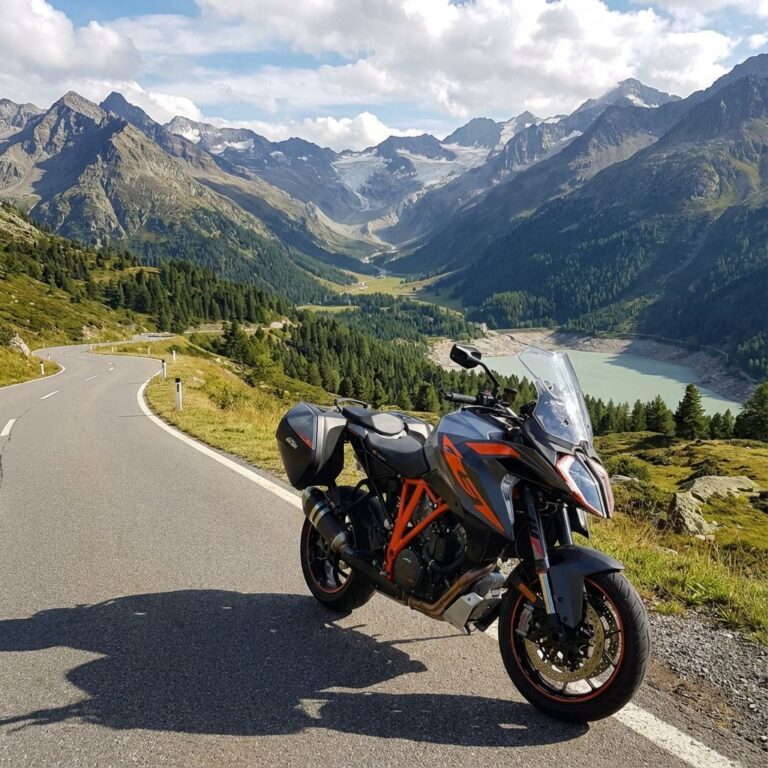
What is a sport-touring motorcycle?


What is a sport-touring motorcycle? This motorcycle combines the performance of a sport bike with the comfort and carrying capacity of a touring bike, allowing you to travel fast and far. A sport-touring motorcycle lets you enjoy a dynamic ride on winding roads while remaining comfortable on long journeys, alone or with a passenger.
In concrete terms, a sport-touring motorcycle It’s designed for motorcyclists who want the best of both worlds: the precision, power, and handling of a sport bike, combined with a more relaxed riding position, superior wind protection, and practical features like panniers, cruise control, and heated grips. It’s for those who love to tackle a mountain pass in the morning and then cover 400 km of highway in the same day without getting off their bikes exhausted. This category has grown considerably in recent years, with increasingly versatile models, often very well-equipped as standard. It sits between pure supersport bikes and large touring motorcycles, and it’s this compromise that makes it a popular choice for high-mileage riders and long-distance travelers.
The characteristics of a sport-touring motorcycle
To fully understand What is a sport-touring motorcycle?First, you need to look at its technical and ergonomic characteristics. This type of motorcycle isn’t defined by a single criterion, but by a coherent set of elements designed to combine sportiness and touring. It’s this combination that distinguishes it from a simple road bike or a slightly modified sport bike.
Driving position and ergonomics
The first noticeable difference compared to a pure sports car is the driving positionOn a sport-touring motorcycle, the rider sits slightly more upright, with less pressure on the wrists and less knee flexion. The handlebars are often higher and wider than on a supersport motorcycle, which improves low-speed control and long-distance comfort.
This ergonomic design has several advantages:
- Reduction of fatigue on long journeys, particularly in the back, neck and wrists.
- Improved visibility in traffic thanks to a higher and more open posture.
- More intuitive control of the motorcycle for daily riding or in the city.
The saddle also plays a central role. On a real sport-touring motorcycleThe seat is generally wider, better padded, and designed to comfortably accommodate a passenger. The seat height is often adjusted to remain accessible to a wide range of rider sizes, while still allowing sufficient suspension travel to cover long distances without causing discomfort to the rider.
In terms of general ergonomics, one frequently finds:
- Footrests less far back than on a sports car, for a more relaxed knee angle.
- Smooth and progressive controls (clutch, brake, accelerator) to limit repeated effort.
- A complete dashboard, often TFT, which displays navigation, fuel consumption, electronic aids and driving modes.
The objective is clear: to allow dynamic driving when the driver wants it, without sacrificing the comfort essential for driving hundreds of kilometers in a row.
Protection and comfort on long journeys
Another essential element for understanding What is a sport-touring motorcycle? is there wind protectionThis is often what makes the difference in everyday life between a motorcycle that is pleasant for 50 km and a machine designed to devour highways.
Sport-touring motorcycles generally have:
- With a partial or full fairing, designed in a wind tunnel to deflect air around the rider.
- With a higher bubble than on a sports car, often adjustable manually or electrically.
- Additional deflectors on some models, to protect the hands, torso or legs.
This protection allows you to ride at sustained speeds without being constantly buffeted or fatigued by wind pressure. On a long journey, the difference in muscular effort is enormous: the shoulders, neck, and back muscles are significantly less strained. This is precisely what makes a sport-touring motorcycle Ideal for fast travel on highways or motorways.
Comfort isn’t just about aerodynamics. You’ll often find, either as standard or optional equipment:
- Heated grips, or even heated seats, for year-round riding.
- Cruise control, which allows you to rest your right hand on the motorway.
- USB or 12V sockets to power GPS, phone, intercom.
- Adaptive or controlled suspension systems, which automatically adjust to the road and the load.
All of this contributes to a truly “touring” use: leaving early, riding for a long time, arriving less tired, while still having a motorcycle capable of delivering a good pace once the right road is found.
Sport-touring vs. sporty: what are the differences?
When we wonder What is a sport-touring motorcycle?It is spontaneously compared to a pure sports bike. They often share a common engine or chassis, but their philosophies of use differ significantly. Understanding these differences helps in choosing the motorcycle that truly meets your needs, beyond the technical specifications.
Engine, chassis and performance
The engines of sport-touring motorcycles They often originate from sports cars or roadsters, but are reworked for more versatile use. This translates to:
- A torque available earlier in the low and mid-range.
- Maximum power is sometimes slightly reduced, but it is more usable on a daily basis.
- A smoother electronic management system, with several driving modes.
The idea isn’t to shine on the track at 14,000 rpm, but to offer strong acceleration when leaving a village, climbing a mountain pass, or overtaking while loaded with luggage. A good sport-touring motorcycle It often offers a wider range of use than a sports bike, and is more flexible at the bottom. This makes it pleasant for riding two-up and traveling.
The chassis further illustrates the sport/touring compromise:
- Frame often derived from a sports car, but adapted to support panniers, top case and additional load.
- Suspensions with more travel and less extreme damping, prioritizing stability and comfort on rough roads.
- Wheelbase sometimes a little longer, to maintain good stability at high speed.
Braking performance generally remains excellent, often borrowed from sport models, with advanced ABS and dedicated modes. Recent sport-touring models also feature aids such as:
- Adjustable traction control.
- Cornering ABS (IMU, inertial measurement unit).
- Up/down shifter for shifting gears up and down without a clutch.
On paper, a pure sports car will retain the advantage in extreme track use, but in real life, on the road, a good sport-touring car already allows you to drive very fast, with much more margin of safety and comfort.
Daily use and versatility
The difference becomes glaringly obvious in everyday use. A supersport motorcycle is designed primarily for lap times and thrills. In the city, on wet cobblestones, in traffic jams, or in the rain, it quickly reveals its limitations: a tight turning radius, a tiring riding position, and a high-revving engine.
A sport-touring motorcycleOn the other hand, it is designed to do everything correctly:
- Going to work during the week, with reasonable consumption and a tolerant attitude.
- Go for a dynamic weekend ride, enjoy a sound chassis and a lively engine.
- To cover several hundred kilometers on holiday, sometimes as a couple and with luggage.
Wind protection, the ability to mount panniers and a top case, and genuine passenger comfort make a huge difference in everyday use. The passenger often benefits from:
- Well-placed grab handles.
- A dedicated saddle, thicker, sometimes raised for better visibility.
- Lower footrests, limiting cramps on long journeys.
An anecdote often comes up among long-distance riders: many motorcyclists who have owned sport bikes end up switching to a sport-touring bike after a long trip. After 3,000 km in about ten days with luggage and, sometimes, back pain, they realize that the few tenths of a second gained on a mountain pass matter less than the pleasure of setting off refreshed every morning. It is often at this point that the sport-touring motorcycle becomes the ideal compromise between passion and pragmatism.
As one flight instructor aptly summarized: “The best motorcycle isn’t the one that’s fastest on a straight line, it’s the one you still want to ride the next day.” For many touring motorcyclists, this motorcycle is a sport-tourer.
The main advantages of a sport-touring motorcycle
To understand What is a sport-touring motorcycle?It also means clearly identifying its strengths compared to other segments. If it is so successful, it is because it ticks many boxes for a wide audience, from the experienced motorcyclist to the returning rider who wants to enjoy themselves reasonably.
Versatility, fun and safety
The first advantage, often cited by owners, is the versatilityA good sport-touring motorcycle can do everything correctly, or even very well:
- Dynamic driving on small roads: precise chassis, powerful braking, responsive engine.
- Long-distance travel: comfort, protection, luggage capacity, autonomy.
- Daily use: suitable position, controlled consumption, electronic assistance.
Driving pleasure remains at the heart of the concept. This is far from a simple “comfortable touring car.” Most sport-touring motorcycles offer high power outputs (often 100 hp and more, sometimes considerably more), very predictable handling, and surprising agility for their size. On a well-paved mountain road, they allow for a very brisk pace with excellent stability.
In terms of safety, this type of motorcycle benefits from the latest advancements:
- ABS in curves : brake hard even when cornering, with more margin.
- Traction control : limits loss of traction during acceleration, especially on wet surfaces.
- Driving modes : rain, road, sport, sometimes customizable.
- LED lighting, sometimes adaptive : better visibility at night.
This combination of enjoyment and safety is particularly appealing to motorcyclists who ride frequently, sometimes in changing conditions or on unfamiliar roads. Having a forgiving, stable, and well-equipped motorcycle allows riders to maintain a safety margin and focus on the road, not on managing the machine’s limits.
Luggage capacity and travel for two
Another decisive advantage of sport-touring motorcycles Their ability to accommodate two people with luggage without compromising stability is key. Standard or optional equipment includes:
- Rigid side cases, often integrated into the lines of the motorcycle.
- A top case, sometimes capable of holding two full-face helmets.
- A specially designed tank bag, with anchor points.
These accessories literally transform the motorcycle. A spontaneous weekend getaway, a week in Europe, or a complete tour of a country becomes much easier to organize: everything fits on board. The motorcycle’s balance is designed to remain stable, even when loaded, provided the recommended weight limits are respected.
For the passenger, sport-touring motorcycles are often an ideal compromise. Unlike a sport bike where you’re perched high, leaning on your wrists, the riding position here is much more natural. The top case can even serve as a backrest, reassuring less experienced passengers. As a result, riding two-up becomes a genuine option, not just a last resort.
A common anecdote among motorcycle couples: many passengers, initially hesitant after a bad experience on a small sport bike or roadster, completely change their minds after a few hundred kilometers on a good one. sport-touring motorcycleThey discover that it’s possible to travel quickly, far, and comfortably, without ending each leg of the journey with back or knee pain. For some, it even sparks plans for grand road trips for two.
Who is a sport-touring motorcycle for?
Know What is a sport-touring motorcycle? That’s not enough; you also need to determine if this type of motorcycle suits your needs. Everyone has different expectations, uses, and experience levels. Sport-touring motorcycles aren’t a one-size-fits-all solution, but they tick many boxes for certain specific rider profiles.
Profiles of motorcyclists concerned
A sport-touring motorcycle is primarily aimed at motorcyclists:
- Those who drive regularly, or even a lot, on roads and highways.
- Those who like to maintain a good pace on secondary roads without sacrificing comfort.
- Those who travel as a couple, with a real requirement for passenger comfort.
- Those who come from a sports car and want something more livable, without sacrificing performance.
For experienced motorcyclists, sometimes in their forties or fifties, who have already had their fill of pure sport bikes, the sport-touring bike is often a logical progression. They retain the pleasure of a precise chassis and a generous engine, while gaining in comfort, safety, and touring capacity. For them, the main criterion is no longer lifting a front wheel in third gear, but being able to enjoy 400 km of winding mountain roads and then return home on the motorway without suffering.
It is also suitable for some motorcyclists returning to riding after a long break. These riders often want to:
- A prestigious, well-equipped, modern motorcycle.
- A position that is neither too tiring nor extreme.
- Enough to travel as a couple or with friends without major limitations.
However, for a first-time A2 license holder, a large sport-touring motorcycle can sometimes feel a bit heavy and powerful. Some models are available in restricted versions, but it’s essential to be honest about your skill level: weight, center of gravity, and power all require a certain amount of practice. A mid-displacement sport-touring motorcycle can be considered for beginners, provided you have proper supervision and ride at a reasonable pace.
Finally, long-distance travelers who cross countries and continents find this type of motorcycle a valuable ally. It is less extreme than a maxi-trail bike in terms of seat height and wind resistance, while offering excellent protection and very predictable handling on paved roads, which make up the majority of their journeys.
Criteria for choosing the right model
Once you understand What is a sport-touring motorcycle? And if we recognize ourselves in the profile, all that remains is to choose the right model. Here are a few key criteria to keep in mind:
- Weight and size When stationary and at low speed, a loaded sport-tourer can be intimidating. You need to be able to maneuver it calmly.
- Saddle height : check that both feet are firmly on the ground, especially when traveling in pairs and with luggage.
- Engine type 2, 3 or 4 cylinders, each architecture has its own character (low torque in the rev range vs explosive acceleration).
- Standard equipment : panniers, adjustable windscreen, cruise control, heated grips, electronically controlled suspension… these can all weigh heavily in the balance.
- Maintenance budget : fuel consumption, servicing, tires (often wide, therefore more expensive), insurance.
It is recommended to try several models before making a decision. A 20-minute trial is not always enough to perceive all aspects of a sport-touring motorcycle Position, windscreen turbulence, two-up riding. Ideally, a longer test ride, or even a weekend rental, is necessary to understand how the motorcycle performs in real-world travel conditions.
Conclusion
Really understand What is a sport-touring motorcycle?It’s about seeing beyond the marketing label. It’s neither a tamed sports bike nor a disguised touring bike: it’s a machine designed from the ground up to combine riding pleasure, solid performance, and long-distance comfort. It allows you to fully enjoy a lively engine and a precise chassis, without suffering the constraints of a radical riding position or insufficient wind protection.
For motorcyclists who ride a lot, who travel, who go two-up, or who simply want a motorcycle capable of doing everything brilliantly, the sport-touring motorcycle It often represents the ideal compromise. It gives the freedom to plan a road trip of several thousand kilometers, to quickly reach the destination via the motorway, and then to enjoy the most beautiful winding roads, all on the same machine.
When choosing a motorcycle, it’s important to be honest about your actual needs, your size, and your skill level. Trying out several models, researching equipment, passenger comfort, and maintenance costs will help you find the most suitable sport-touring motorcycle. Once you’ve made the right choice, it often becomes much more than just a means of transport: a true travel companion, capable of accompanying your journeys for many years to come.
Frequently Asked Questions about Sport-Touring Motorcycles
Is a sport-touring motorcycle suitable for beginners?
It all depends on the model and the rider’s size. Some mid-displacement sport-touring motorcycles, restricted for the A2 license, can be suitable for a motivated and well-trained beginner. On the other hand, large, heavy, and powerful models are best reserved for motorcyclists with considerable experience, particularly in managing the weight at low speeds and the power when exiting corners.
What is the difference between a sport-touring car and a GT (grand touring car)?
The GT prioritizes maximum comfort and travel capacity above all else, often resulting in a higher weight, a very wide seat, extensive electronics, and sometimes an almost “armchair-like” riding position. sport-touring motorcycle It aims to be more dynamic: lighter, more agile, with a sportier feel on winding roads, while remaining comfortable for travel.
Can you ride a sport-touring motorcycle on the track?
Yes, it’s possible to ride a sport-touring motorcycle on a track, especially during recreational track days. However, it won’t be as comfortable as a supersport (weight, ground clearance, riding position). It remains a good option for discovering the track, working on your lines and braking, provided you accept the inherent limitations of this type of machine.
Is a sport-touring motorcycle comfortable for the passenger?
Overall, yes, it’s actually one of its strong points. A more comfortable passenger seat, lower footpegs, better wind protection, and the option to mount a top case with a backrest make long journeys much more pleasant than on the back of a sport bike or roadster. However, it’s advisable to test ride the motorcycle with a passenger before buying.
What budget should be allocated for the maintenance of a sport-touring motorcycle?
Maintenance costs vary depending on the model, but generally, you should budget more than for a smaller engine. Wide tires, oil, brake pads, and labor for servicing can represent a significant expense, especially if you drive a lot. On the other hand, the quality of the components and the reliability of recent models are often very good.
Do you absolutely need panniers to talk about sport-touring motorcycles?
No, having suitcases is not mandatory, even if it is very common. What primarily defines a sport-touring motorcycleIt’s the combination of sportiness (engine, chassis) and touring capabilities (comfort, protection, cargo space). Some sport-touring motorcycles are sold without luggage as standard, but can easily be fitted with it as an option.
Does a sport-touring motorcycle consume a lot of fuel?
Fuel consumption varies depending on engine size, riding style, and type of journey. Under normal riding conditions, many modern sport-touring motorcycles achieve between 5 and 6.5 liters per 100 km. In very dynamic riding or at high speeds on the motorway, consumption can increase, as with any powerful motorcycle, but generally remains acceptable for this level of performance.
What is the best sport-touring motorcycle?
There is no single “best” sport-touring motorcycle, only models more or less suited to different uses. Some prioritize raw power, others comfort, and still others value for money. The important thing is to try several models, clearly define your priorities (performance, comfort, two-up riding, electronics, budget), and choose the one that gives you the most confidence on the road.
Is it possible to travel abroad without worry with a sport-touring motorcycle?
Yes, it’s even one of his favorite playgrounds. With a good sport-touring motorcycleYou can travel through several countries, link highways, and enjoy mountain roads. All you need to do is ensure your vehicle is up-to-date with maintenance, have suitable insurance for travel abroad, and perhaps carry some basic spare parts (bulbs, fuses, tire repair kit).