Full Exhaust Line: Before/After Performance

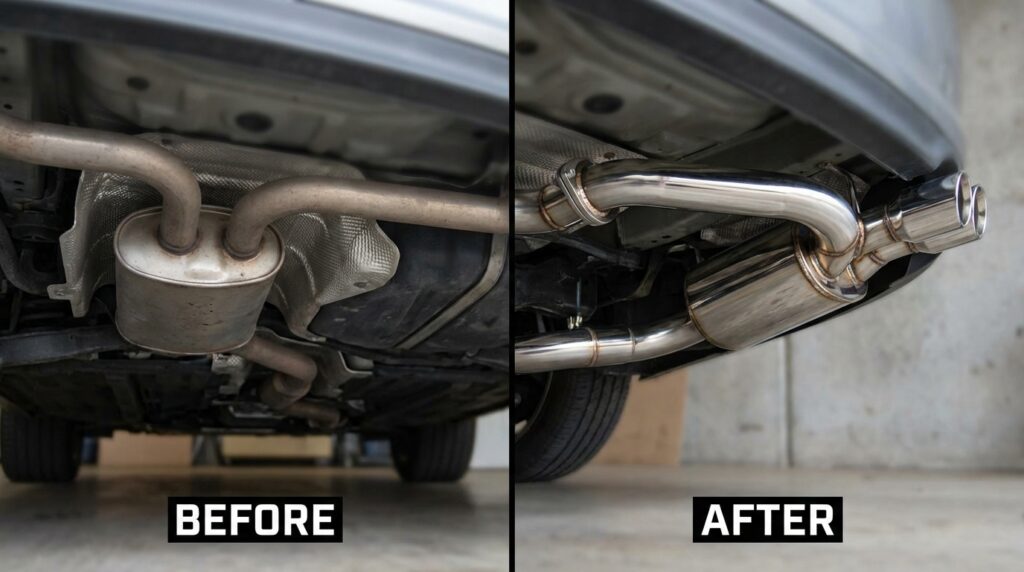
Engine performance is often at the heart of enthusiasts’ and specialized technicians’ concerns. Among the many possible modifications, the installation of a complete exhaust system stands out as a major option to optimize a vehicle’s capabilities. Indeed, this modification not only affects power and torque, but it also influences the total weight and the exhaust sound, two essential parameters for thrill seekers. The power gain from a well-designed exhaust system can radically transform driving, from comfort to sporty handling.
From a technical standpoint, replacing an original exhaust system with a high-performance complete system significantly improves the airflow, thus reducing constraints on the engine. This reduction of back pressure promotes optimized combustion, increasing effective power while improving responsiveness. Moreover, the weight reduction thanks to the use of lighter materials, such as stainless steel or titanium, provides a notable advantage in the vehicle’s agility and handling. This justifies the growing enthusiasm for sport exhausts in the tuning sphere in 2026.
At the same time, the exhaust sound is inseparable from the user experience, directly translating mechanical performance into a unique acoustic signature. Changing the complete system affects this parameter, with modulation of sound frequencies ranging from a deep and muffled purr to a more aggressive and sporty tone. This characteristic is often at the center of drivers’ concerns who seek to combine auditory pleasure and mechanical gains. Like other preparations such as the complete Focus ST preparation, installing a well-calibrated complete system is one of the essential modifications to explore.
Technical analysis of a complete exhaust system: operation and impact on engine power
The complete exhaust system integrates all components located at the engine outlet, including the manifold, the catalytic converter, the intermediate pipes, and the silencer. Its main role is to efficiently evacuate burnt gases while minimizing back pressure, which slows down the engine.
One key factor for improving airflow lies in the very design of the pipelines. Original exhaust systems are often designed with a restricted diameter and many bends to comply with emission standards or to maintain conservative sound comfort. By substituting these elements with a complete system featuring straighter conduits and optimized diameter, pressure loss is reduced and evacuation efficiency maximized. The direct consequence is more complete combustion within the cylinders, resulting in a noticeable power gain and a significant torque improvement, especially in high rpm ranges.
This strategy is confirmed by power bench tests conducted before and after installation. For example, a Subaru WRX prepared with a suitable complete exhaust system can see its engine torque increase by 15% to 20% while gaining roughly 10 horsepower. These figures are typical and obviously depend on the engine but underline the real impact of this improvement. The decrease in exhaust gas temperature due to better evacuation also helps protect engine components and ensure longer durability.
The choice of materials also contributes to this optimization. Stainless steel offers a good compromise between corrosion resistance and lightness, while titanium combines the advantages of lightweight and robustness for the most demanding applications, notably in competition. However, beyond the simple technical choice, it is essential to comply with current approval standards, under penalty of having the vehicle rejected during technical inspection. In this regard, following the complete procedure for tuning homologation in France is a must for any serious preparer.
Therefore, a careful exhaust installation is not limited to a simple hardware replacement but involves a global reflection on the harmonization of all mechanical and electronic parts of the vehicle.
Complete exhaust system: influence on sound and auditory feel before/after modification
Just like the power gain, the impact of a complete exhaust system on the exhaust sound draws particular attention. The emitted sound directly reflects modifications in the exhaust gas path and the silencer design.
Before modification, original exhausts favor a soft sound, often almost inaudible to those not initiated into sporty driving. Their design includes expansion chambers and catalytic converters aimed at limiting noise, in compliance with road regulations. This sometimes excessive compromise disappoints enthusiasts looking for a more expressive acoustic signature.
After installing an appropriate complete system, the sound becomes more dynamic and amplified thanks to the reduction of obstacles to gas flows. Acoustic improvement can translate into a deeper, sportier tone, bringing a feeling of power at full throttle. The reduction of mass in the system itself also decreases parasitic vibrations and strengthens perceived sound quality.
Among the tricks used to modulate sound, there are intermediates with adjustable valves, offering the possibility of a variable sound on demand. These systems allow adapting noise according to usage, from city driving to the track. This technology is notably seen in some premium range preparations, such as Mercedes AMG models, where the distinction between stage 1 and stage 2 tuning includes exhaust adjustment.
Concrete example: a Golf GTI equipped with a sport exhaust enhances its power not only through engine gain but also through an immediately recognizable sound signature, visually and audibly reflecting its preparation.
Weight and ergonomics: weight reduction thanks to a complete exhaust system and its influence on vehicle dynamics
Besides power and sound, the complete exhaust system influences the overall dynamics of the vehicle by acting on weight. Original exhaust systems often incorporate heavy parts, notably made from conventional steel, which can weigh down the structure and impact agility.
Switching to a complete sport system made of light materials contributes to a significant decrease in unsprung mass, with several mechanical consequences. A lightened vehicle becomes more responsive in acceleration and mid-range power, but above all more agile in corners due to reduced inertia. This benefit is amplified, notably on compact cars such as the Clio RS in advanced preparation.
In the table below, we observe the average weight difference between an original exhaust system and a complete sport system:
| Type of vehicle | Original system weight (kg) | Complete sport system weight (kg) | Weight gain (kg) |
|---|---|---|---|
| Compact city car | 12.5 | 7.8 | 4.7 |
| Sport sedan | 15.3 | 9.9 | 5.4 |
| Sports car | 18.6 | 11.2 | 7.4 |
Weight reduction on the rear part of the vehicle also affects mass distribution, favorably contributing to torque improvement and better feeling at the wheel. This factor, often underestimated, makes all the difference when the car is pushed on the track or in a dynamic environment.
Complete exhaust installation: practical advice and common mistakes to avoid
Installing a complete exhaust system is not limited to a simple part exchange; it must meet precise criteria to ensure efficiency and safety. The first step is to choose a system adapted to the model and performance objectives of the vehicle. The assembly must be carried out under optimal conditions by a professional to ensure perfect sealing and limit the risk of leaks at the joints.
A crucial point concerns the adjustment of the system, notably the position of bends and supports, which must respect the base geometry to avoid any mechanical stress. Furthermore, alignment with electrical and thermal components of the rear axle must be precise to avoid any damage caused by excessive heat.
The following list details the major steps for a successful complete installation:
- Choose a system compatible with the engine and engine mapping.
- Prepare the vehicle: remove the old system and inspect the mounts.
- Install progressively while checking alignment, fastening, and flexibility.
- Leak test and verification before regular start-up.
- Engine remapping if necessary to exploit performance gains.
- Compliance with emission standards and post-installation technical inspection.
Many preparers recommend pairing the exhaust with other modifications such as installing a sport air filter or integrating an external wastegate to precisely adjust boost pressure and optimize gains, as detailed in the article on external wastegate tuning.
Avoid classic mistakes, such as approximate mounting or choosing an unapproved system, which is essential not to compromise either performance or safety. A complete preparation like the one detailed for the Subaru WRX shows that the coordination between the exhaust and engine management is the key to a significant improvement.
Overview of the best sport exhaust brands in 2026: selection criteria and performance before/after
The sport exhaust offering in 2026 is characterized by a significant diversification of brands and available technologies. To make the best choice, it is advisable to analyze several criteria: the material used, the design (straight line or with specific bends), compatibility with the vehicle, as well as the expected performance in terms of weight reduction and power gain.
Several brands currently dominate the market for enthusiasts and professionals alike. Manufacturers like Akrapovic, Milltek, Remus, and Borla offer high-end solutions delivering measurable gains in engine torque and power while enhancing sound.
Here is a comparative presentation of the performance produced by an original exhaust system versus a high-end sport system:
| Parameter | Original system | Complete sport system | Improvement (%) |
|---|---|---|---|
| Power (hp) | 220 | 240 | +9.1% |
| Torque (Nm) | 320 | 365 | +14.1% |
| Weight (kg) | 14.0 | 9.0 | -35.7% |
| Sound level (scale) | 5/10 | 8/10 | +60% |
These variations represent average figures, of course depending on engine type and specific configurations, but illustrate the huge potential of a good exhaust preparation. It is always recommended to rely on feedback and tests before validating a choice.
To deepen the tuning approach on related aspects, discover the complete support for the Clio RS and essential mods which harmoniously combine exhaust, aerodynamics, and engine management.
What is the main advantage of a complete exhaust system compared to a simple silencer?
The complete system acts on the entire gas evacuation circuit, improving airflow, reducing back pressure, and optimizing combustion, which significantly enhances power and torque, unlike a simple silencer which primarily modifies the sound.
Can a complete exhaust system impact fuel consumption?
Yes, by improving engine efficiency thanks to better gas evacuation, it can contribute to more efficient consumption, especially in dynamic driving, although the effect may be moderate depending on vehicle configuration.
Is it necessary to remap the engine management after installing a new complete system?
In most cases, yes. Remapping allows fully exploiting the performance gains by adjusting injection and ignition parameters adapted to the engine’s new operating regime.
Can all vehicles benefit from a sport complete exhaust system?
Most vehicles can benefit from improvements, but care must be taken to choose a compatible system and comply with approval standards. Some very specific engines may require more complex adaptations.
Is the louder sound after installation regulated?
Yes, regulations impose decibel limits for vehicles in circulation. It is important to choose an approved system and verify legal constraints before installation to avoid penalties.