Additional Tuning Box: Does It Really Work?

In the world of car tuning, the tuning box is often presented as a simple and economical solution for increasing power and optimizing engine performance. Whether for gasoline or diesel cars, this accessory promises a noticeable improvement in engine power and fuel economy, while guaranteeing quick and reversible installation. However, given the diversity of models, the multitude of promises made by manufacturers, and the growing enthusiasm for engine remapping, one question remains: does the tuning box really work, and what are its true benefits and limitations?
Among tuning enthusiasts, opinions are mixed. Some owners boast of significant power gains with immediate car optimization, while others are skeptical, pointing to disappointing results or a lack of long-term reliability. Based on real-world tests, detailed technical analyses, and comparisons with other performance enhancement methods, this report delves into the facts to separate fact from fiction surrounding this component that has become essential in the world of personalized automobiles. We will explore, in particular, the actual impact on fuel consumption, how the control unit is installed, and even the consequences for the vehicle’s mechanics.
Technical operation of the additional control unit and its effects on engine performance
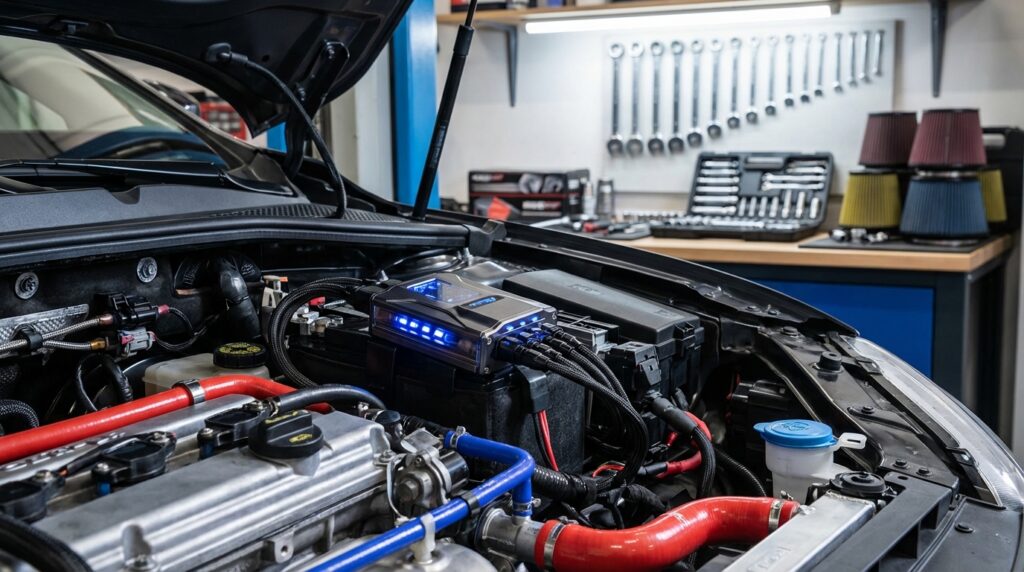
A tuning box is an electronic module that operates in parallel with the engine control unit (ECU). Its main role is to modify the engine’s injection and sometimes turbocharging parameters, which can lead to a significant power increase. For diesel engines, it works, for example, by optimizing the quantity and pressure of the injected fuel, while for gasoline engines, it can modify the ignition timing and the air/fuel mixture.
This device captures certain engine data and then injects modified signals to “trick” the ECU into adopting a more efficient behavior. However, this intervention is limited: it does not replace a true custom engine reprogramming. It is rather a one-off, standardized optimization.
In practice, the control unit is usually installed on the fuel injection system or on the pressure and temperature sensors. This procedure is quick, often completed in under an hour, without requiring major mechanical modifications. The ease of installation partly explains the growing popularity of this equipment among enthusiasts.
Concrete examples of performance gains
Tuning box tests conducted on popular models, such as the Ford Focus ST, show gains ranging from 10 to 20 horsepower. However, these figures are highly dependent on the engine model and the quality of the tuning box. In the case of a Focus ST tuning, complete Ford preparationAdding the additional control unit is a first step before considering more advanced reprogramming.
For a Mercedes A45 AMG, it is common to combine the tuning box with engine remapping to achieve more advanced tuning levels, as described in the preparation A45 AMG Tuning Stage 1 to Stage 3This combination allows the engine’s full potential to be exploited while controlling fuel consumption. The control unit then acts as a technical springboard, facilitating a gradual and controlled increase in power.
It should be noted, however, that lower-end tuning boxes can lead to increased fuel consumption or premature engine wear. Reliability of tuning is directly linked to the quality of the equipment and its compatibility with the vehicle.
Effect of the additional control unit on fuel economy: myth or reality?
The promise of improved fuel economy is often touted by sellers of tuning boxes. The idea is based on optimizing the air/fuel ratio, which should theoretically improve combustion and thus reduce fuel consumption. The technical question then becomes whether this improvement is actually noticeable in real-world driving conditions.
In several tests conducted on equipped vehicles, the results show a slight decrease in average fuel consumption, sometimes as much as 5-7%. However, this remains highly dependent on driving style: aggressive or sporty driving will negate this gain and can even significantly increase fuel consumption.
It is important to understand that the additional control unit does not fundamentally modify the engine; the improvement comes from better electronic management but often at the cost of increased injection pressure, which can lead to faster mechanical wear in the long term.
Comparative analysis with other car optimization methods
Compared to using a tuning box, a complete engine reprogramming remains the most effective way to boost performance and optimize fuel consumption. This method completely modifies the injection, turbo management, and ignition maps, allowing for precise adaptation to the vehicle model and configuration.
For example, the preparation BMW M3 tuning, Stage 1, 2 and 3 preparation This approach is perfectly illustrated. In comparison, the add-on module represents a simpler and more economical alternative, but one that offers fewer possibilities for precise adjustment.
To conclude on fuel economy, the additional box can indeed contribute to a slight optimization, but this improvement will remain marginal and very dependent on the conditions of use, even if it is a marketing argument often put forward.
Installation of an additional control unit: method, precautions and vehicle compatibility
Installing a tuning module is not something to be done haphazardly, even though most models can be quickly connected to diagnostic connectors or specific sensors. To guarantee reliable and safe optimization, it is recommended to follow certain rigorous technical steps and avoid a “do-it-yourself” approach.
The kit usually comes with detailed installation instructions, indicating precisely where and how to connect the module to the vehicle. If in doubt, it’s best to consult a professional car tuner rather than attempting a rough installation. Improper installation could lead to engine faults or premature wear of parts.
- Check the compatibility of the unit with the vehicle model and year.
- Perform a preliminary electronic diagnostic to ensure the absence of faults.
- Follow the manufacturer’s instructions and avoid touching sensitive mechanical components.
- Road test required after installation to validate performance and detect any anomalies.
- Respect the vehicle’s warranty and check if adding the device does not compromise it.
Successful installations have been recorded on common vehicles, such as the Ford Focus in its complete tuning preparationThis makes the installation accessible even for enthusiasts with basic tools. In contrast, some modern cars with complex electronics may not allow this type of optimization, posing a problem with tuning reliability and integrating the unit into the CAN bus network.
This technical requirement is increasing with the evolution of engines and anti-pollution standards, which increasingly limits the scope of action of simple additional modules.
Additional control unit review: user feedback and testimonials
Tuning expert tests of add-on modules show varying degrees of effectiveness depending on the module and the car. Several owners report a more responsive engine feel, with improved acceleration and a slight improvement in low-end torque. These improvements technically correspond to a power increase achieved through more generous fuel injection or revised timing.
For a specific context, on a car like the BMW M3, a test carried out as part of a BMW M3 tuning Stage 1-3 preparation This reveals that an additional control unit can complement a remap, particularly in stage 1 where adjustments remain minor. However, beyond that, a complete remap is necessary for significant and more lasting gains.
Negative feedback often highlights a lack of customization options, or even malfunctions when using an incompatible control unit. The absence of precise control over engine management can lead to emissions violations, a critical point given current legal requirements.
In conclusion, even if it does not replace a complete engine reprogramming, the additional box test confirms that this system can be an effective solution for initial optimization and a step towards more advanced preparations, as seen in the tuning of the Focus ST or the A45 AMG.
Reliability of tuning and limitations of the additional control unit in modern contexts
The reliability of engine tuning depends primarily on the quality of the control unit’s design and its compatibility with the engine. Inexpensive models, often available without manufacturer certification or validation, pose a significant risk to the engine’s mechanics. These units can lead to premature injector wear, engine overheating, or electronic failures.
Faced with these risks, some manufacturers are focusing on certified products tailored to specific models, thus guaranteeing safe and sustainable car optimization. The development of limited recalibration algorithms, compliant with anti-pollution standards, paves the way for more responsible tuning.
On the other hand, with the rise of on-board electronics and sophisticated engine management systems, the abusive or inappropriate use of the additional box tends to become obsolete, gradually replaced by engine reprogramming diagnosed and adjusted by professionals.
The table below summarizes the advantages and technical limitations of the additional control unit:
| Criteria | Benefits | Boundaries |
|---|---|---|
| Facility | Simple, quick, no engine disassembly required | Compatibility varies depending on the vehicle |
| Performance | Immediate, accessible engine gain | Limited to partial optimization |
| Fuel economy | Slight improvement possible | Depends on driving style |
| Reliability | Certified safe products | Low-end cases at risk |
| Engine longevity | Compliance with manufacturer’s specifications (if quality is maintained) | Wear and tear may occur if misused |
For more in-depth tuning, it is advisable to switch to advanced engine remapping solutions with complete software control, as illustrated in the A45 AMG Stage 1-3 Tuning PreparationThis ensures efficient optimization with a balanced risk between performance and sustainability.
Is the additional control unit compatible with all cars?
No, compatibility depends on the model, year, and engine technology. It is essential to check the specifications before purchasing.
Can you install an additional control unit yourself?
Yes, but it is recommended to have technical skills or consult a specialist to avoid any damage.
Does the additional control unit guarantee a significant power increase?
It allows a moderate power increase, sufficient for basic optimization, without equaling a complete engine reprogramming.
Does this have an impact on the manufacturer’s warranty?
Adding a control unit may void the manufacturer’s warranty if the modification is not declared or approved.
Does the additional control unit actually improve fuel consumption?
A slight improvement is possible, but it depends heavily on driving style and conditions of use.