Common Mistakes in Vehicle Wrapping and How to Avoid Them

Vehicle wrapping is increasingly popular with drivers thanks to its ability to completely transform a vehicle’s look without traditional painting. However, this technique requires extreme care. Common wrapping mistakes, whether due to poor surface preparation or an imperfect application technique, can compromise both durability and the final aesthetic. From air bubbles and tears to choosing the wrong wrapping film, each step demands precision and meticulous methods. Understanding these pitfalls and how to avoid them is essential for enthusiasts, professionals, and novices alike who strive for a flawless and long-lasting result.
Adopting a rigorous approach from the preparation stage is essential to prevent poor adhesion, creases, and premature film aging. This article explains the main causes of these errors and provides practical advice, supported by techniques, material choices, and suitable solutions. Through several concrete examples and in-depth analysis, we decode best practices and the essential wrapping tools needed to master each phase: surface cleaning, precise cutting, and meticulous finishing. Furthermore, additional resources are included to deepen your understanding of the subject, particularly regarding… the essential steps to a successful vehicle wrap or even the post-installation quality control.
Surface preparation: the key to avoiding major covering errors
The success of a vehicle wrap fundamentally depends on a surface preparation Rigorous and meticulous preparation is essential even before the film is applied. This preliminary work is often neglected, leading to the first wrapping errors that compromise proper adhesion.
A thorough cleaning of the surface is essential to remove all traces of wax, grease, dust, or previous treatments. If these contaminants persist, they not only cause poor adhesion but also the formation of bubbles and creases under the film, weakening the wrap over time.
To do this, it is recommended to use specific degreasers and suitable cleaners that are gentle on the bodywork. A careful inspection under diffused light will reveal any paint imperfections such as micro-scratches or small dents that must be repaired before application. The slightest roughness will disrupt the film during application and can cause the wrap to tear in areas of weakness.
Furthermore, temperature and the work environment greatly influence the quality of the application. A hot or dusty surface makes perfect adhesion impossible. An air-conditioned workshop or controlled environment is recommended, particularly for drying conditions. To explore this aspect further, consult the dedicated article on… surface preparation for a durable coating.
In summary, coating errors related to preparation mainly manifest themselves as:
- Insufficient cleaning leads to poor adhesion and air bubbles.
- Failure to treat paint defects increases the risk of tearing or deterioration.
- Inadequate environmental conditions that disrupt the application and finishing of the coating.
Adopting these good practices ensures a homogeneous, resistant and aesthetically flawless installation.
Air bubbles and poor adhesion: diagnostics and effective solutions
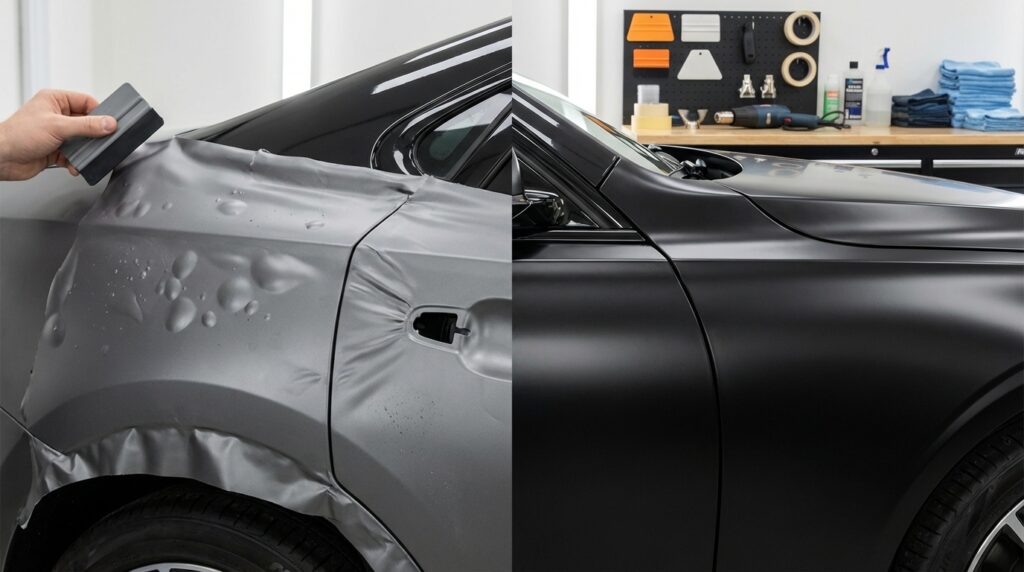
Air bubbles frequently appear when the vehicle wrap is applied without proper technique or due to an improperly prepared surface. They constitute a major aesthetic defect and a sign of poor wrap durability.
These air pockets are caused by the presence of dust, dirt, or by creases formed when the film is applied too quickly without being properly tensioned. installation technique plays an essential role here. For example, the heating method using a heat gun or a heat gun is often essential to soften the film, facilitate its stretching and avoid bubbles.
Another critical point lies in the use of appropriate wrapping tools. A good quality felt squeegee, of the correct size, allows you to push air out of the film from the inside to the outside without damaging it. The movement must be controlled, methodical, and systematic, and the pressure must be adjusted to the area being treated.
In some cases, localized air bubbles can be gently pierced with a fine needle and the area compressed with a squeegee. However, this must be done carefully to avoid creating irreversible tears in the coating.
Poor adhesion can also stem from choosing an unsuitable wrapping film. Lower-quality or overly rigid films don’t always conform to the vehicle’s complex curves, which accentuates bubbles and creases. It’s therefore recommended to opt for films from recognized brands, with guaranteed elastic properties and compatibility with the surface type. Several technical data sheets and product tests are available to guide this choice, as explained in our comprehensive comparison of… Cost of vehicle wrapping versus professional paintingwhere film quality is a key factor.
To minimize covering errors related to air bubbles and poor adhesion, the precautions to follow can be summarized as follows:
- Ensure impeccable surface cleaning.
- Choose a vehicle wrap film that precisely matches the surface and curves of the vehicle.
- Mastering the application technique, including heating and movements with the right covering tools.
- Manage the installation in a clean and temperature-controlled environment to avoid dust and condensation.
Tears in vehicle wraps: common causes and how to prevent them
One of the major risks in vehicle wrapping is tearing, often the result of improper handling or a material defect. These incidents can be costly as they often involve the complete or partial replacement of the film, or even a more complex repair.
Tears occur mainly when the film is stretched too tightly during application or when attempts are made to reposition it repeatedly. The high mechanical stress weakens the material, particularly on sharp corners, edges, or around handles. Excessive or inappropriate use of sharp tools also increases this risk.
Furthermore, poor surface preparation, with rough areas, can increase the film’s resistance when stretched, promoting perforation.
To avoid these tears, it is imperative to:
- Perform optimal surface cleaning to obtain a smooth and homogeneous surface.
- Use high-quality covering films with good elongation and sufficient thickness.
- Use professional tools designed for installation, such as those described in our article on Essential materials for vehicle wrapping.
- Adopt a suitable application technique, in particular by moderately heating the film and avoiding any excessive tension.
A good practice is to make precise cuts in strategic locations using proven methods. This facilitates film handling and drastically reduces the formation of creases or tears during repositioning, as detailed in professional cutting and fitting techniques.
Real-life example: during a wrap on a compact sports car, a tear occurred at a door crease due to excessive stretching. Repairs required the complete replacement of the panel, resulting in a significant additional cost and compromising the overall aesthetic finish.
Film covering and finishing options: optimizing aesthetics and durability
Choosing the right vehicle wrap film is crucial to avoid recurring adhesion problems and ensure a flawless visual result. This choice involves analyzing the technical properties: thickness, elasticity, UV resistance, and the quality of the liner to protect the film before application.
By 2026, technological advances in polymer films will make it possible to combine performance with a variety of aesthetic appearances: matte, glossy, satin, carbon effect, pearlescent… These covering finishes not only provide a personalized style but directly influence how the film behaves when applied.
For example, a matte film requires more delicate handling because it reveals any surface imperfections more clearly and is more prone to fingerprints. Conversely, a glossy or satin film can conceal minor flaws while offering a luminous finish.
The importance of attention to detail in the finishing touches and edges of the vehicle wrap should not be underestimated. Careful edge smoothing, sealing of openings, and the application of a protective varnish enhance the aesthetic appeal and durability. Find all these tips in the guide to… The finishing touches and edges that make all the difference in vehicle wrapping.
The table below summarizes the advantages and disadvantages of the main finishes:
| Covering Finish | Benefits | Constraints |
|---|---|---|
| Mast | Modern and sleek look, low reflection | Sensitive to marks, requires special care |
| Bright | A deep, mirror-like effect that camouflages certain flaws. | May reveal scratches and micro-imperfections |
| Satin | Elegant and soft appearance, a compromise between matte and glossy | More rigorous maintenance is needed to preserve the effect |
| Carbon | Textured, sporty, highly sought-after effect | More complex to install, risk of visible lines |
Post-installation checks and maintenance: ensuring the longevity of the wrap
Once the application is complete, the work doesn’t stop. Errors can still occur at this stage if post-application quality control is rushed or if maintenance is neglected. This final phase is crucial to guarantee the durability and optimal protection of the vehicle’s bodywork.
It is advisable to wait for the entire wrap to dry and harden before exposing the vehicle to external stresses such as high-pressure washing or prolonged parking in direct sunlight. The duration of this waiting period, which varies depending on the film, is detailed in the article on the drying time and hardening of the coating.
Post-installation quality control involves a meticulous inspection to detect any persistent bubbles, finishing defects, or areas at risk of peeling. Routine maintenance must follow specific protocols to prevent film degradation and the proliferation of micro-scratches that detract from its appearance.
An effective checklist includes:
- Checking edges and joints to ensure a good seal.
- Regular cleaning with non-abrasive products specifically designed for vehicle wrapping.
- Avoid using overly aggressive high-pressure cleaners.
- Periodic inspection of areas exposed to shocks, friction or contamination.
Adopting a rigorous approach and this post-installation monitoring greatly limits covering errors and prolongs the life of the film, thus enhancing the value of the investment made.
How to avoid air bubbles when applying a vehicle wrap?
Thorough cleaning of the surface, the use of good covering tools such as felt squeegees, as well as a mastered application technique with heating of the film are essential to effectively remove air bubbles.
What are the signs of poor surface preparation before covering?
Air bubbles, poor adhesion, creases and tears in the covering can indicate insufficient cleaning or the presence of contaminants on the bodywork before application.
Which vehicle wrap finish is the easiest to maintain?
Glossy finishes are generally more forgiving of imperfections and easier to clean than matte finishes, which require more delicate care to avoid marks.
Can a tear in a vehicle wrap be repaired?
A small, localized tear can sometimes be repaired with specific techniques, but generally, partial or total replacement of the affected panel is necessary to ensure a clean and durable finish.
Why is post-placement monitoring crucial?
Post-installation inspection allows for the rapid identification of defects such as bubbles, peeling or finishing problems in order to intervene quickly and guarantee the longevity of the covering.