Professional Tools for Vehicle Wrapping: Essential Equipment

The world of vehicle wrapping has experienced explosive growth in recent years, transforming the way vehicles are personalized and protected. Whether for a unique aesthetic touch or impactful mobile advertising, applying adhesive films has become an effective alternative to traditional paint. But behind this accessible and popular technique lies a demanding world, where the quality of the professional tools used plays a crucial role in the final result and the durability of the wrap. From squeegees to heat guns, each essential piece of equipment is designed to ensure a precise, flawless, and bubble-free application, while respecting the specific requirements of modern vehicle surfaces.
For professionals and experienced amateurs alike, choosing and mastering these tools is essential for transforming a simple adhesive film into a true automotive transformation. This technological evolution continues to innovate, incorporating measuring tools like tape measures and laser levels to guarantee error-free cutting and perfect surface alignment. At the same time, preserving the integrity of both the film and the bodywork requires protective accessories, such as protective gloves, which are indispensable for working safely and preventing any damage during handling.
Discover how a professional wrapper’s complete equipment, combined with rigorous technique, ensures optimal application, from preparation to the most meticulous finishing. Practical tips for avoiding common pitfalls like air bubbles and creases, as well as the use of innovative tools to sculpt the film to the vehicle’s complex shape, are at the heart of this detailed exploration.
The key role of professional tools in the preparation and application of adhesive film
The success of a vehicle wrap depends first and foremost on meticulous preparation and the rigorous use of appropriate professional tools. Beyond the adhesive film itself, it is the combination of equipment and expertise that will determine the quality and durability of the wrap. The preparation phase, where the surface must be perfectly clean and smooth, is crucial. It is essential to ensure that the bodywork is free of dust, grease, or any other residue that could compromise adhesion.
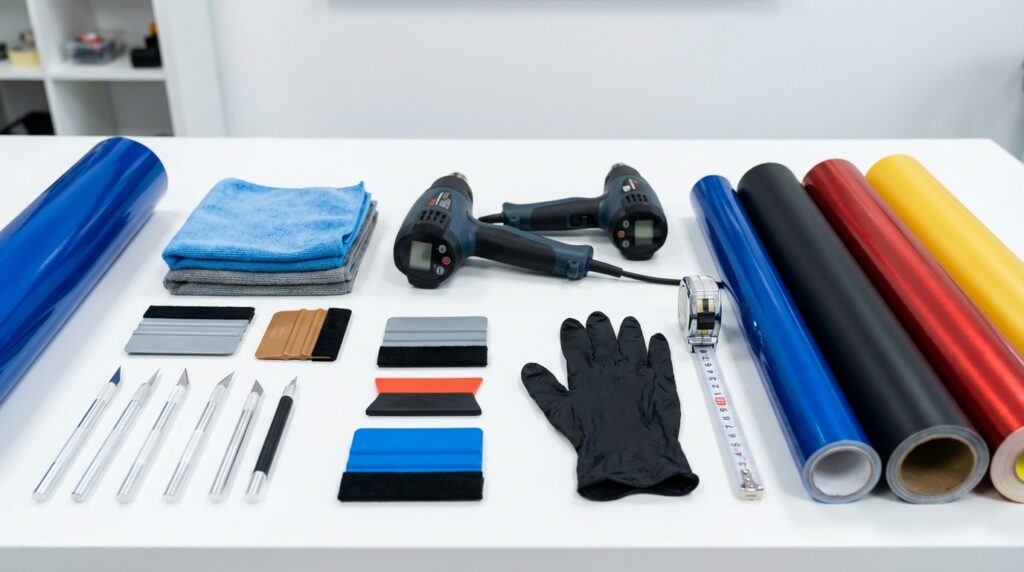
Among the essential tools is the tape measure, an often underestimated piece of precision; it allows you to accurately measure the dimensions of the panels to avoid wasting film and ensure complete coverage. Installation cannot begin without a precise cutting tool; the precision cutter is therefore essential for obtaining clean cuts adapted to the complex lines of a vehicle. Without it, the edges risk being uneven, which would compromise not only the aesthetics but also the durability.
The squeegee, often considered the quintessential tool for vehicle wrapping, facilitates the application of the adhesive film by progressively removing air and excess water from beneath it. It’s thanks to this tool that the professional installer can smooth the film, prevent bubbles, and ensure perfect adhesion. Some squeegees even have flexible tips designed for corners and curves, allowing for easy adaptation to all the specific shapes of vehicle bodies.
For the heating phase, essential for the film’s thermoformability, the hot air gun is the most common tool. It makes the film more pliable, allowing it to be molded into complex shapes and eliminating tension that could lead to peeling or creases. Controlling the temperature and heating distance is crucial to avoid damaging either the film or the underlying paint.
Finally, to guarantee the installer’s safety and the quality of the work, protective gloves become an essential tool. They prevent leaving fingerprints or scratching the freshly coated surface and protect hands from cuts when using a utility knife. The quality of this equipment reduces physical strain, improves precision, and contributes to the overall success of the installation.
The different types of tools and their specific features for a successful vehicle wrap
The market for tools dedicated to vehicle wrapping is vast and constantly evolving towards greater precision and adaptability. Each tool fulfills a specific function, whether it be cutting, application, finishing, or quality control. We will detail these professional tools, highlighting their technical characteristics and practical uses.
Precision cutters: selection and maintenance
A precision cutter is not simply a sharp knife, but a sophisticated tool that must combine ease of use with a sharp blade. Several types of dedicated cutters exist, notably with straight or curved blades, each suited to a specific use. For example, the curved blade is particularly well-suited for rounded corners and intricate cuts around door handles or rearview mirrors.
Regular blade maintenance is essential to prevent premature wear, which can lead to film tears and visible defects. Replacing the blades at the first signs of wear ensures a clean cut, facilitating the final film adjustment stage.
Professional squeegees: materials and shapes
The squeegees used for vehicle wrapping vary depending on the density of the rubber or foam and the shape of the tip. A hard plastic squeegee will provide better pressure on flat surfaces, while a squeegee with a flexible tip adapts to contours and prevents scratches. Squeegees with special notches are also available to facilitate water drainage and prevent bubbles from forming under the film.
Hot air guns: parameters to master
The heat gun is a key tool for molding the film to the bodywork; however, its operation requires skill and care. The temperature must be adjusted according to the type of adhesive film to avoid thermal shock. The heating distance and movement speed must be controlled to prevent burning the paint or melting the film.
In some cases, accessories such as diffusion nozzles allow you to concentrate or widen the flow of hot air for a more targeted result on difficult areas.
Measuring instruments: precision and control
A tape measure and laser level play a crucial role in ensuring consistent dimensions and proper alignment of the film across the entire vehicle surface. The laser level is particularly useful for verifying that the film is applied straight on long and curved surfaces, thus preventing unsightly misalignments that could compromise the final result.
By integrating these measurement tools into the workflow, the installer can optimize their time and gain in precision, which directly impacts the quality perceived by the customer.
Tips to avoid common mistakes when applying vehicle wraps, including essential equipment
Despite the quality of professional tools, applying vehicle wraps can sometimes encounter difficulties, mainly due to technical errors or improper use of the equipment. Here are several practical tips to optimize each step of the application process and minimize the risk of errors such as air bubbles or creases.
Rigorous preparation and optimal cleaning
Before applying any adhesive film, the surface must be perfectly clean and degreased. Using a specific cleaner, followed by complete drying, is essential. If any residue or dust remains, even professional equipment cannot guarantee perfect adhesion. Proper preparation ensures the longevity of the wrap.
Mastering the unrolling and alignment
Unrolling the film is a delicate step, where a tape measure and laser level prove invaluable. The installer must verify that the measurements correspond to the vehicle model and that the film is correctly positioned before beginning to press down with the squeegee. Any error at this stage will be difficult to correct, hence the importance of precision.
Avoiding air bubbles: a matter of tools and technique
The squeegee is the main tool for effectively removing air bubbles. The movement should be regular and progressive, starting from the center and moving towards the edges. this resourceYou can find plenty of advice on how to master the application and ensure a perfectly applied, smooth film.
Targeted heating for efficient thermoforming
Using a heat gun precisely makes it easier to mold the film onto complex shapes without excessive stress on the material. By following expert advice and referring to guides such as those available on thermoforming of the filmThe installer can achieve professional finishes comparable to those of the best workshops.
Recent innovations in professional vehicle wrapping equipment
The market for vehicle wrapping equipment is evolving rapidly, with the emergence of increasingly ergonomic and precise tools that facilitate the work of both qualified installers and experienced amateurs. These innovations help reduce application time while improving the quality of the finish.
Among the latest advancements are multi-functional squeegees equipped with interchangeable systems that allow them to move from flat surfaces to curved areas in seconds. This represents a significant time saving in professional settings. Similarly, some cutters now incorporate special non-stick blades that prevent sticking to the film during cutting, an innovation that reduces material waste.
Hot air guns benefit from technological advancements, with digital temperature and flow rate settings ensuring better adaptation to different types of films, whether matte, gloss, satin, or carbon fiber effects. These intelligent settings help prevent errors related to overheating and optimize the durability of the wrap over time.
Finally, the integration of laser technology for measurement and guidance allows for increased precision. Laser levels are now combined with augmented reality tools to visually guide the installation in real time, minimizing imperfections and facilitating the management of film strips over large areas.
Quality control and maintenance of essential equipment for vehicle wrapping
Once the installation is complete, quality control is an essential step to ensure a flawless result. It also requires the use of appropriate and precise equipment to detect even the slightest irregularity. Ensuring that the edges are clean, that the film adheres properly everywhere, and that any small bubbles have been eliminated are key criteria for success.
Professional quality guides recommend using measuring tools to verify the film’s flatness and the accuracy of the angles. During this phase, a thorough examination under both natural and artificial light is crucial. Solutions exist to facilitate the detection of imperfections, such as the use of UV lamps or visual inspection strips.
Regular tool maintenance, often neglected, plays a role in the overall performance of the equipment. A worn cutter or a dirty scraper can seriously compromise a project, and poorly cleaned heat guns may malfunction during delicate applications. It is therefore recommended to store these tools under optimal conditions and to follow a systematic inspection and cleaning protocol.
Furthermore, the choice of high-quality materials and their periodic replacement guarantee consistent efficiency and strengthen customer confidence. Professionals and discerning amateurs alike will find this attention to detail a key to achieving excellence.
| Professional tool | Main utility | Key Features | Maintenance tips |
|---|---|---|---|
| Raclette | Removing bubbles and applying the film | Soft/flat tips, non-abrasive material | Clean after each use to avoid residue. |
| Precision cutter | Clean and precise cut | Thin blade, blades can be changed | Change the blades regularly to maintain sharpness |
| Hot air gun | Thermoforming of the film | Digital setting/variable temperature | Clean the nozzle and check the cables |
| Tape measure | Precise surface measurement | Appropriate length, clear marking | Avoid twisting and deformation |
| Protective glove | Hand and film surface protection | Durable materials, good adhesion | Replace if worn or punctured |
| Laser level | Perfect film alignment | Self-leveling function, extended range | Store flat and protect from impacts |
Industry professionals know how much the efficiency and longevity of their equipment impact the final quality of their vehicle wraps. Mastering the essential equipment involves more than just its use; it also requires rigorous maintenance to guarantee consistent stability and performance.
To learn more, see this article dedicated to the complete equipment of the professional wrapperan essential resource to deepen your mastery of the equipment.