Turbo Upgrade : +100hp on Your Car


In the world of car tuning, achieving a significant power gain remains an exciting technical challenge. The “Turbo Upgrade” is now established as an essential solution to boost engine performance and noticeably increase torque. Car enthusiasts know that this modification goes far beyond a simple accessory addition; it requires a detailed understanding of injection systems, electronic management, and the thermal constraints associated with boosting. The main objective is clear: to guarantee a power supply that is both efficient and reliable. With the constant evolution of technologies and replacement parts, it is now possible to consider an increase of over 100 horsepower on a car, becoming a real “game changer” for tuning fans.
Whether it’s for a Subaru WRX, a Peugeot 206, or a Civic Type R, each model demands a specific approach to fully exploit the turbo’s capabilities. This power increase translates into a meticulous adaptation of mechanical and electronic components, notably the precise addressing of the ECU, often through reprogramming, and a suitable evolution of the injection system. The technical challenges are therefore multiple and require an in-depth knowledge of onboard systems. This article analyzes in detail the steps, components, and impacts of a successful turbo upgrade, to help each enthusiast realize this power gain efficiently and mechanically safely.
The Fundamentals of Turbo Upgrade for +100hp: Understanding the Power Booster
The turbo, as a forced induction system, plays a crucial role in increasing the power of a combustion engine. Its principle is based on recovering energy from exhaust gases to compress more air into the combustion chamber. This improves the density of intake air, allowing for a richer fuel combustion and thus a notable increase in engine power.
To achieve a rise of more than 100 horsepower thanks to a turbo upgrade, it is essential to understand that all system elements must be in perfect synergy. The boost pressure must be adjusted according to the resistance of the engine’s internal components. If the turbo generates too much torque without the pistons, connecting rods, and crankshaft being reinforced, the risk of mechanical failure becomes high.
Besides the mechanical parts, electronic management makes all the difference. ECU reprogramming is essential to optimize injection and deliver the correct amount of fuel according to the boost. Without this, a sudden boost increase can cause a lean mixture in the cylinders, leading to knocking and premature wear. For example, a complete stage 2, combining a larger turbo, reinforced injection, and calibrated electronic management, is often the key to a real, durable power gain, as shown in advanced tuning projects detailed in this technical article.
Another crucial aspect concerns cooling. Boost increase produces more heat in exhaust gases and compressed air. Installing a high-performance intercooler becomes mandatory to avoid detonation and ensure optimal combustion. This component also acts as a thermal barrier protecting the turbo and improving engine longevity, as detailed in this article on the tangible benefits of an improved intercooler.
Essential Mechanical Modifications for Efficient Additional Power
Upgrading to a larger turbo alone is not enough to guarantee a gain of +100 horsepower. Appropriate mechanical modification is crucial to exploit this power without compromising engine reliability. The upgrade often involves rebuilding or replacing several critical components, as well as integrating new specific parts.
Reinforcement of Internal Components
To withstand increased engine torque, the original pistons, often made of cast iron or basic alloy, must be replaced by forged models, which are more resistant to pressure and heat. Connecting rods follow this logic: reinforced steel parts allow withstanding the increased torque without deformation. The crankshaft must also be checked to avoid any structural weakness.
These modifications not only protect the engine but also ensure stable operation during intensive use. It is an indispensable step when aiming for stage 3, where power can exceed 300 horsepower, far beyond a simple 100 hp increase.
Optimization of the Injection System
The injection system, a key element, must evolve to deliver sufficient fuel flow with precise atomization. Replacing injectors with high-capacity models is necessary to avoid a lean mixture under high boost. Coupled with reprogramming, this ensures optimal combustion, reducing consumption and the risks linked to knocking.
High-performance fuel pumps, as well as adjustable pressure regulators, are often integrated into these setups. This system is detailed and compared on various reprogramming platforms, notably in this comprehensive guide on ECU management and its optimization.
The Adapted Exhaust System
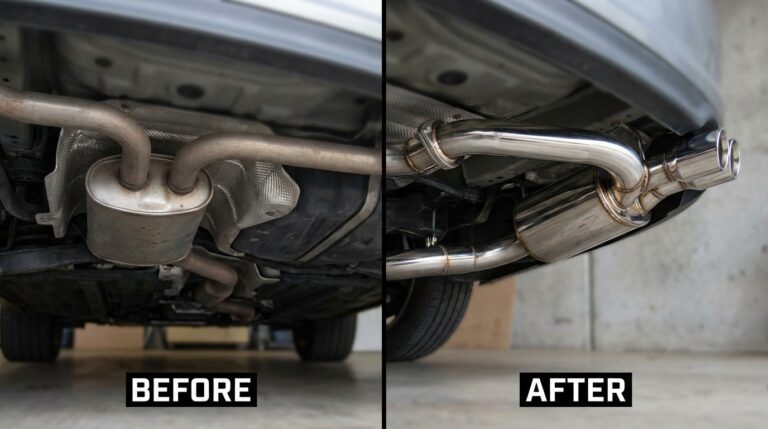
Restriction at the exhaust outlet is a significant barrier to power increase. An optimized full sport exhaust line promotes smooth flow, reducing backpressure and increasing turbo efficiency. A sports muffler and adapted manifolds are recommended to fully exploit the delivered boost.
| Component | Required Modifications | Impact on Power |
|---|---|---|
| Pistons | High-strength forged pistons | Supports torque increase, stabilizes power |
| Connecting Rods | Reinforced steel rods | Prevents deformation under high pressure |
| Injectors | High capacity injectors | Optimizes fuel-air mixture under boost |
| Fuel Pump | High-pressure pump | Stable fuel supply |
| Exhaust Line | Complete sport line, optimized manifolds | Reduces backpressure, increases efficiency |
ECU Reprogramming: The Cornerstone of the Turbo Upgrade and Engine Management
More than just a mechanical modification, a +100hp turbo upgrade involves deep adaptation of the onboard electronic management. ECU reprogramming acts precisely on injection mapping, ignition timing, and boost control to optimize every phase of the engine cycle.
Poorly calibrated mapping can lead to an unsuitable mixture, knocking, or torque drop-offs, harming both power and engine longevity. That is why tailored reprogramming – often by tuning specialists – is essential.
Modern reprogramming also incorporates adaptive control, adjusting in real time based on engine and environmental conditions. This allows for reliable performance gains while limiting overheating and breakdown risks. This step is precisely described in this article on additional control boxes and their real effectiveness.
In some cases, optimization may include integrating an additional box before full reprogramming, thus allowing to test the impact on power without compromising safety. This step is often recommended to validate gains before final modifications.
The Concrete Benefits in Performance and Associated Risks of a Turbo Modification
Feedback from enthusiasts and professionals shows a clear improvement in dynamic performance after a turbo upgrade. An increase of +100 horsepower significantly changes peak power and engine torque, facilitating acceleration and improving top speed.
Unlike a simple change of tip or air filter, the turbo upgrade impacts the very essence of the engine, pushing it to its limits with precise control. Here are the most frequently noted benefits:
- Measured power gain: The true power delivered by the engine is increased and validated on a test bench.
- Improved torque from low revs: A more efficient turbo delivers instant boost for better responsiveness.
- Optimized fuel consumption: Combining adapted injection and better combustion, consumption can be rationalized despite increased power.
- More sporty sound: The optimized exhaust enriches the car’s acoustic signature.
- Customization of settings: Each owner can adapt engine character according to preferences thanks to the flexibility of reprogramming.
However, such a project is not without risks. Increasing pressure in the engine heavily stresses components, potentially shortening their lifespan if installation is poorly done. Moreover, low-quality parts or sloppy reprogramming can cause severe malfunctions, up to total engine damage. The intervention of a serious expert is imperative to minimize these risks.
The example of a complete turbo preparation for a Subaru WRX, detailed here there, perfectly illustrates the necessary securing steps for durable increased performance.
Practical Steps to Successfully Achieve a Turbo Upgrade +100hp on Your Car
Realizing a turbo upgrade requires a minimum of planning and suitable equipment. Here are the essential steps to guarantee an optimal and lasting result:
- Complete engine diagnosis: Assess the general condition, check compressions, and test the injection system.
- Select the turbo and compatible parts: Ensure proper adaptation to your engine (size, max pressure, flow).
- Mechanical preparation: Replace pistons, connecting rods, and injectors as needed.
- Install the turbo upgrade with a high-performance intercooler system.
- Assemble an optimized exhaust system for better gas evacuation.
- ECU reprogramming on the test bench with precise boost and injection adjustments.
- Break-in and optimization phase: Check the power curve, adjust if necessary, monitor engine temperature.
- Reliability tests: Intensive driving to detect any mechanical or electronic weaknesses.
Each step requires rigor and expertise. Enthusiasts can draw inspiration from already completed projects, such as the full preparation of a Peugeot 206 on a controlled budget, with details available in this reference article.
Following this protocol, it is possible to significantly increase your car’s performance while ensuring engine durability. A good upgrade is never just a simple assembly of parts, but a precise orchestration of every interacting element.
Is it possible to install a +100hp turbo upgrade on all cars?
Most cars with combustion engines can benefit from a turbo upgrade, but success depends on engine compatibility and the quality of components used. Some naturally aspirated engines also require additional modifications to accommodate a turbo.
What is the importance of ECU reprogramming in a turbo upgrade?
ECU reprogramming is fundamental to adjust the management of injection and boost, to optimize power and ensure mechanical reliability against increased pressure.
Can engine reliability be improved after a turbo upgrade?
Yes, by reinforcing internal components like pistons and rods, and installing a high-performance intercooler, risks of failure related to increased pressure are limited. Regular maintenance is also essential.
What are the risks of poor turbo installation?
Poor installation or bad calibration can cause knocking, overheating, or even mechanical failures, severely compromising engine reliability and vehicle safety.
Are there alternatives to turbo upgrades for gaining power?
Yes, solutions like additional control boxes or improving direct intake can offer power gains but generally less than turbo upgrades. Learn more about these alternatives in this dedicated article.