The 7 Steps to a Successful Car Wrap [Illustrated Guide]

Car wrapping has become an essential solution for personalizing your vehicle while protecting its bodywork. Faced with growing demand, mastering the various techniques is crucial. covering steps has become essential, whether you are a knowledgeable amateur or a professional in the field. This sophisticated process relies on the use of a covering film Adhesive film, capable of radically transforming a car’s appearance without the need for traditional painting, which is often expensive and time-consuming. More than just a change of look, vehicle wrapping meets precise technical requirements, particularly in the choice of the appropriate film, meticulous vehicle preparation, and the quality of the application.
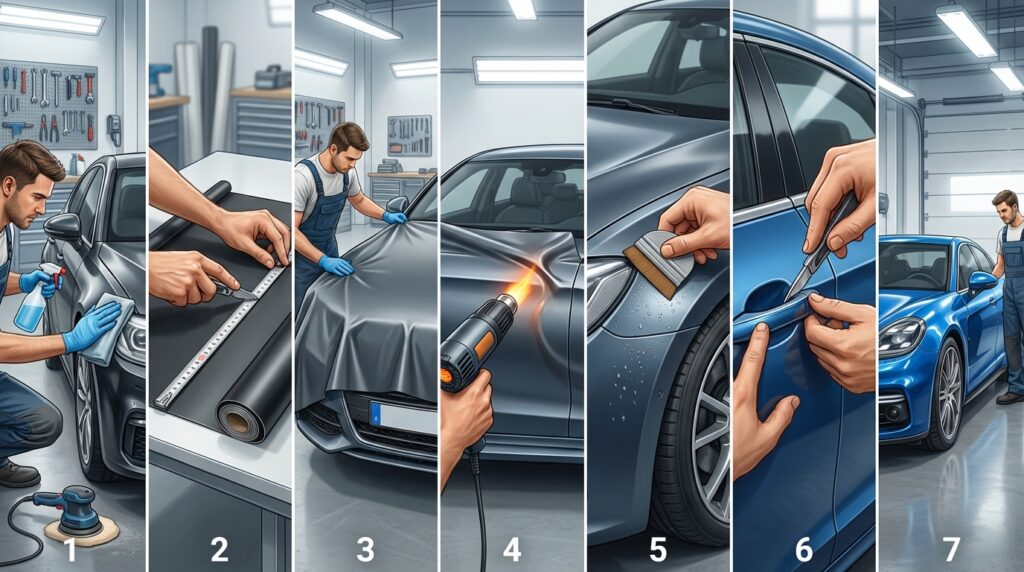
Combining aesthetics and protection, this technique helps preserve the vehicle’s value, especially for resale, while also simplifying maintenance. For example, a driver opting for a vehicle wrap can easily protect their car’s bodywork from scratches and UV damage, thus extending the lifespan of the original paint. Numerous practical examples and technical guides are now available online, offering genuine expertise to ensure a perfect installation, whether on a compact city car or a high-end SUV. This illustrated guide will walk you through the process. covering steps : from the vehicle preparation passing through the disassembly parts, THE bodywork cleaning until themovie app then the finishing.
Vehicle preparation: an essential foundation for a flawless car wrap
The success of a car wrap depends first and foremost on a meticulous preparation of the vehicleThis crucial step determines the optimal adhesion of the film and ensures a long-lasting bond. The surface must be perfectly smooth, clean, and free of grease before any application. Any trace of dust, grease, wax, or old adhesive layers will compromise the quality of the installation. Therefore, thorough cleaning with specific degreasing products is recommended. A complete wash followed by rigorous drying is essential, especially in sensitive areas such as door frames, wheel arches, and pillars.
Furthermore, the disassembly parts This may be necessary to ensure a perfect installation and a flawless finish. Components such as door handles, mirrors, badges, and bumpers are often removed to prevent creases or bubbles from forming during film application. This process requires precise expertise to avoid damaging fasteners or seals. In some cases, particularly for full wraps, disassembly extends to more complex elements, demanding patience and skill.
It’s also important to check the condition of the bodywork before application. If there are deep scratches or dents, repairs should be considered beforehand, as the wrap doesn’t completely conceal these imperfections. For those who want to learn more about the application process, the suitability of a wrap on a car with scratches is discussed in this article: Can a car wrap be applied to a scratched car?.
To optimize this step, setting up a suitable workspace is also essential. Working in a temperature-controlled, dust-free environment with appropriate lighting greatly facilitates precise application. Every professional or experienced amateur should consider this phase as a rigorous technical foundation before proceeding to the following stages.
Choosing the wrapping film and preparing the equipment technically
Vehicle wrap film is at the heart of the aesthetic transformation. From quality to finish, it determines not only the visual appearance but also the wrap’s longevity and ease of maintenance. Among the most popular options in 2026, several finishes stand out: glossy, matte, satin, chrome, carbon fiber, or even textured films imitating leather or brushed metal. The choice depends on the owner’s desired look, as well as the intended use and expected durability.
For example, matte and satin finishes offer a modern and elegant style, often favored by those who appreciate subtle customization, while glossy films emphasize the depth and shine of a classic clear coat. Carbon fiber film, a more technical option, provides a distinctive texture that highlights specific areas such as mirror housings or grille surrounds. This wide range of options encourages careful consideration of technical specifications: film thickness, UV protection, scratch resistance, and the ability to conform to the vehicle’s complex shapes.
A key point concerns the technical preparation of the tools. For a installation covering For optimal results, it is recommended to use heat guns to facilitate shaping, squeegees with soft pads to avoid damaging the surface, and precision cutters for clean cuts. Ambient temperature and applied heat must be carefully controlled to ensure the film relaxes properly and adheres without forming creases or bubbles.
Here is a handy list of parameters to consider when choosing and preparing the film:
- Film/vehicle compatibility: check that the film is suitable for the existing paint and materials used on the bodywork.
- Sustainability : opt for a film with a warranty against yellowing and tearing of at least 5 years.
- Desired finish: glossy or matte depending on the desired style.
- Ease of application: Some films are more stretchable, increasing ease of application.
- Maintenance and cleaning: Choose a film that is easy to wash and resistant to chemicals.
To better understand the cost differences and the choice between a wrap and traditional paint, it is helpful to consult a Comparative analysis of the cost of vehicle wrapping versus professional paintingThis link sheds light on the value for money of each solution, a decisive advantage of covering in many situations.
Detailed techniques for perfect vehicle wrap application
After preparing and selecting the film, the critical step of application comes the wrapping itself, the true technical heart of the transformation. The application must be carried out with extreme precision: the slightest imperfection will result in creases, air bubbles, or poorly adhered areas that detract from both the aesthetics and the durability. The procedure begins with the approximate cutting of each section of film, followed by its positioning on the surface, taking into account the shape and technical contours of the vehicle. The film is handled delicately to avoid any uncontrolled excessive stretching that could distort the design or damage the adhesive.
Skilled operators use heat guns to soften the film, allowing for better adaptation to convex or concave shapes such as wheel arches or door corners. Tensioning and smoothing are then carried out with specialized spatulas, applying even pressure to expel air from under the film and ensure uniform adhesion. For critical areas, particularly panel joints, it is essential to create an invisible overlap to prevent water or dirt from penetrating under the film.
The process must follow this order for optimal installation:
- Position and center the film on the area to be covered.
- Heat gently to soften, without overheating.
- Spread gradually with the spatula, expelling air bubbles.
- Emphasize areas of fold or complex folding with controlled heating.
- Carefully trim off any excess film.
- Check for good adhesion and smooth one last time before complete drying.
In addition to manual techniques, recent innovations allow for faster application of vehicle wraps without compromising quality. Some self-adhesive films with microscopic vents facilitate air release, thus reducing defects. This progress aligns with observations made in Fast application of the wrap: transform your car in 2-3 daysillustrating how the profession is evolving towards greater operational performance.
Finishing touches for a professional finish: detail and perfection for a professional result
Once the cover application is complete, it is essential to work on the covering finish To enhance the result and ensure the film’s longevity, areas such as window surrounds, door frames, and mirror housings require special attention to prevent premature lifting due to water or friction. These visible points are typically reworked with precise cuts and, if necessary, the application of smaller film sections.
A specific product, a finishing varnish or sealant, can be applied to enhance UV resistance and limit the accumulation of dust or contaminants. These products are chosen according to the type of film used, as some composites offer better compatibility with certain varnishes or scratch-resistant treatments. Maintaining a well-finished wrap is also simpler, as this focus on… Simplified maintenance: why vinyl wrapping makes cleaning easier.
The reversibility of the wrap must also be considered. One of the biggest advantages of vehicle wrap film is that it can be removed without damaging the original bodywork, a reassuring factor for users concerned about resale value. This aspect is discussed in more detail on [link/page]. Reversibility of the wrap: restore your original paintwork.
| Type of finish | Visual appearance | Resistance | Interview |
|---|---|---|---|
| Mast | Velvety, anti-reflective finish | Good scratch resistance | Gentle cleaning recommended |
| Bright | Mirror effect, glossy finish | Less resistant to micro-scratches | Easy to clean with a microfiber cloth |
| Satin | Balance between matte and glossy | Medium resistance | Regular cleaning recommended |
| Carbon (textured) | Visible relief, sporty effect | Very good resistance | Specific care with gentle products |
As part of a meticulous finishing process, adjusting the angles and checking the joints ensures a consistent and professional result. By mastering these final steps, a truly harmonious aesthetic transformation is achieved, enhancing the vehicle’s unique style.
Maintenance and tips to prolong the effect of the wrap on your car
Once the wrap is applied and perfectly finished, maintaining its shine and functionality requires appropriate care. Unlike traditional paint, wrapping film simplifies certain operations but requires some special precautions. For example, the use of high-pressure cleaners is recommended in moderation to avoid lifting or gradual peeling of the film.
It is important to use gentle products, free of harsh solvents, and to favor microfiber cloths to avoid micro-scratches. Furthermore, the washing frequency can be reduced, as the protective film helps repel dirt and insect residue, making cleaning quicker and less frequent. This characteristic is clearly highlighted in Protection against scratches and UV rays: vehicle wrapping as a shield.
An often overlooked point concerns the regular monitoring of areas exposed to intense friction (door frames, hood, lower fender areas). These parts may require minor touch-ups or the application of vinyl repair patches, a simple technique to extend the life of the wrap without costly intervention.
It is also recommended to park the car in the shade or under a shelter to minimize excessive sun exposure. Of course, when choosing the film initially, prioritize one with good UV resistance, a requirement that has greatly improved in recent years.
Here is a list of practical tips for optimal maintenance:
- Avoid high-pressure jets at distances of less than 30 cm.
- Use neutral car shampoos specifically designed for vinyl film.
- Wipe with soft microfiber cloths.
- Do not expose the vehicle to direct sunlight for too long without protection.
- Conduct regular inspections to identify any detachment.
Finally, for those still wondering about the legality and restrictions related to vehicle wrapping, it is helpful to consult this practical guide on Is it legal to put a wrap on your car?providing a comprehensive overview of the regulations in force.
Does the wrap damage the original paintwork?
If the film is applied and removed correctly, it does not damage the original paintwork, allowing for great reversibility as explained in our dedicated article on the reversibility of the covering.
Can you install a vehicle wrap yourself?
It’s possible to apply a vehicle wrap yourself, especially with self-adhesive films designed for beginners, but this requires great precision and careful preparation. For a professional result, using a certified installer is often recommended.
Does the covering protect against scratches?
Yes, the wrapping film offers effective protection against light scratches and UV damage, contributing to the preservation of the original bodywork, as detailed in This item.
What is the lifespan of a vehicle wrap?
The lifespan of a vehicle wrap film generally varies between 5 and 7 years depending on the quality of the film, the exposure conditions, and the maintenance performed. Some premium films can exceed this duration.
Can the car wrap be changed to change the color of the car?
Absolutely, changing the car’s color with a wrap is a quick and economical alternative to traditional painting, without compromising the original coating, as explained in This item.